Drought and dust
According to NASA, portions of Interstate 35 in Kansas and Oklahoma, as well as Interstate 80 in Wyoming, had to be shut down due to accidents and poor visibility. Click on the photo for the full resolution image and text from the Earth Observatory.
“Parched by months of drought and searing heat, the Great Plains of the United States endured a widespread dust storm in mid-October 2012,” reports NASA’s Earth Observatory. “Severe winds blew soil and sediment across hundreds of miles, closing highways and reminding longtime residents of the Dust Bowl years of the 1930s and the severe dust storms of the 1950s.”
…
Arctic sea ice at record seasonal low
The extent of arctic sea ice is at the lowest seasonal minimum in the satellite record since 1979 according to the National Snow and Ice Data Center.“Hottest month on record for the nation”
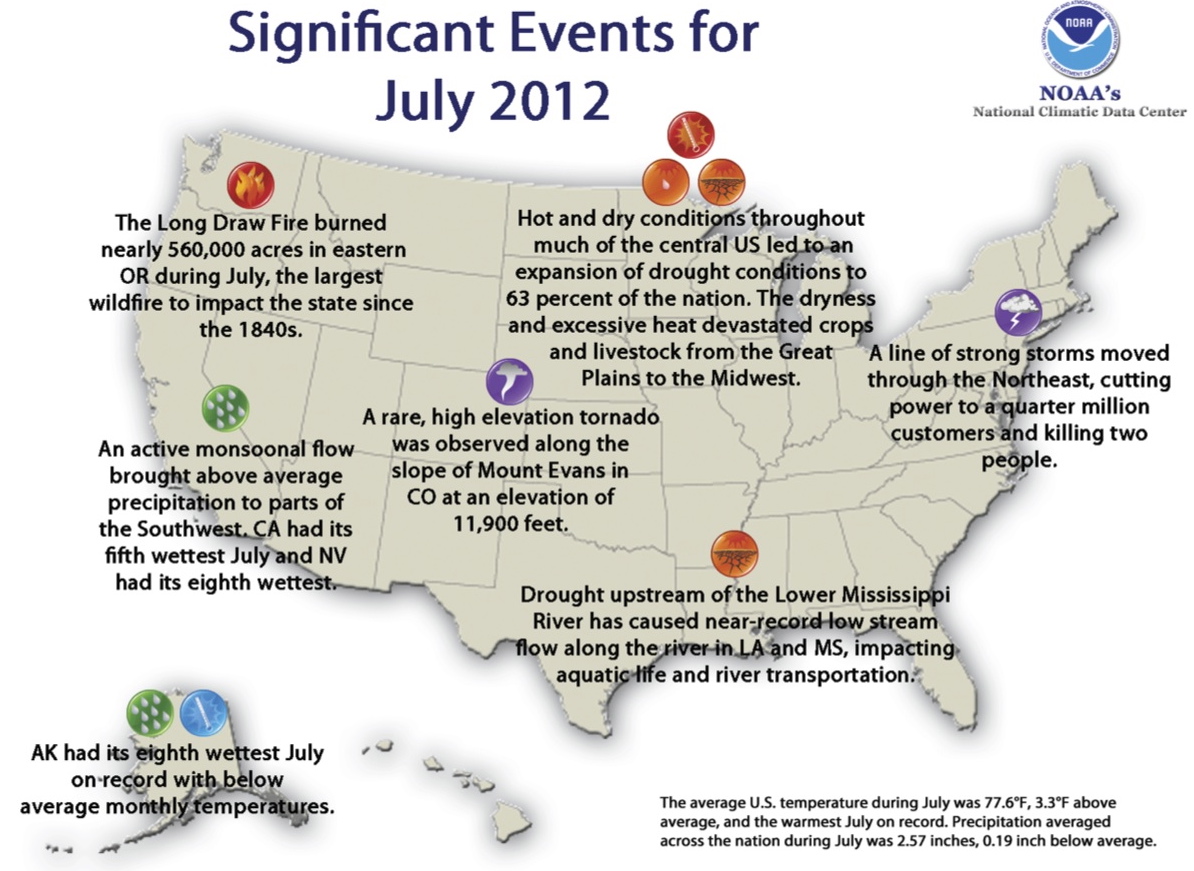
July 2012 was “3.3°F above the 20th century average, marking the hottest July and the hottest month on record for the nation,” reports the National Oceanic and Atmospheric Administration. Click here for the report or on the image to enlarge it.…
Hot earth day
"Most of the US experienced record or near-record breaking temperatures, contributing to the warmest March since national records began in 1895," reports the National Oceanic and Atmospheric Administration. Click on the map for NOAA's March 2012 global climate analysis. After reading it, if you live in Southern California, Nevada, Arizona etc, what are you waiting for? Rip out your lawn. It will save roughly half of the water you use, the often dirty energy needed to pump that water hundreds of miles from wet places to dry ones, the energy needed to mow the lawn once a week, the air pollution caused by the mowers, and the energy needed to cart away and process the green waste. For support on landscape alternatives, check your local native plant society.
A genius caught between theft and heroism
Pacific Institute president and MacArthur Foundation fellow Peter Gleick impersonated a board member of an organization dedicated to denying climate change for all the right reasons but it now threatens his distinguished career. Is he a hero or a criminal -- or both? keep looking »North American Native Plant Societies

After the lawn

Garden blogs
