The Dry Garden: Eco-snooping
The problem with selling native plants in garden centers is that the natives are reluctant seducers. For much of the autumn and winter — prime planting months in California — they’re discreet. Their foliage comes in the understated colors of a Craftsman paint palette. Give the plants too much water, and they rot in their pots. Flowers are few. Only in spring, usually far from town, safe distances from our hoses, do native lilacs lead the charge into blossom with a cobalt-blue eruption. After them come the pink and white spires of coral bells and clarkia, masses of orange poppies, along with every color of penstemon, irises and monkeyflowers. Only shoppers who know what a native looks like in spring can envision its potential in the fall, when it’s time to buy and plant.

By comparison, exotic plants are favored by retailers because their leaves often come in leprechaun greens. …
The Dry Garden: Log love
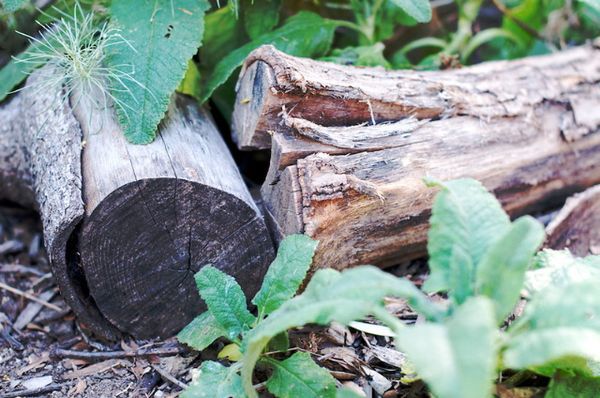
Hackberry and coral tree wood gives loft to a bed with the hummingbird sage and an almost insect-like tendril of Artemisia californica (upper screen left). Photo copyright: Diane Cu / whiteonricecouple.com. Reprinted with permission.
In taking nature apart and putting it back together again in our gardens, we err toward the refined. This is the case with mulch. Nowhere is it written that it has to come chipped, much less in a bag from a store. In fact, there is much to be said for laying it down by the log.
Click here to keep reading today’s Dry Garden column on the beauty and benefit of deadwood in the garden. Or for full listings of dry garden events for June and July, click here.
Diane Cu’s photograph comes from this writer’s garden; on Cu’s first visit she was immediately struck by the texture and form of the deadwood and …
The Dry Garden: UCLA in theory and in practice
Stephanie Landregan, program director of the UCLA Extension Landscape Architecture & Horticulture program. Click on the image to find out about certificate courses. Photo: Emily Green
Nobody ever said that doing the right thing was easy. Students in UCLA Extension’s landscape architecture and horticulture program now learn this before leaving with a certificate. “All of our advanced design classes used to be make-believe,” said Stephanie Landregan, appointed program director two years ago. “Now every one of our advanced classes is involved with the community. Every one of our students has real projects and reality checks. The big ideas get tested.”
Just such a test happened in November, when an undergraduate from UCLA’s environmental science department contacted Landregan wanting to know how his class might introduce a water-efficient landscape somewhere on the 400-plus-acre campus. Landregan partnered his class with a group of her graduate extension students, and the team soon …
The Dry Garden: ‘Canyon Prince’
OF ALL the creatures that disperse plants in nature, we humans may be the quirkiest. Take how we distribute New Zealand flax. We fight back its blades along what seems like every other front walk.
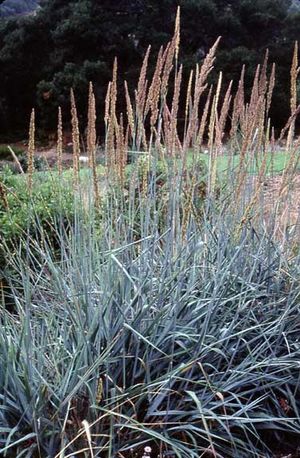
This column is to commend an indigenous alternative to New Zealand flax for the gardens of greater Los Angeles: a type of giant wild rye called Canyon Prince. Ninety-nine percent of the time that flax is used in California, this cultivar of Leymus condensatus could perform the same function, but better.
To keep reading the lastest installment of the Dry Garden in the Los Angeles Times, click here.…
The Dry Garden: ‘Sustainable Landscaping for Dummies’
The idea that suburban gardens might be “sustainable” came late to Southern California. Modern Los Angeles was sold on the promise that anything grows. Exotic plants were status symbols. Sunshine was constant, and the only worry about water was finding plants best suited to go next to the swimming pool. More than a century later, the fantasy style is out. Sustainable is in. There’s only one problem. What does sustainable mean?
Landscape architect Owen Dell has cut through the eco-babble to offer not just a definition, but also a how-to book. The Santa Barbara-based author of “Sustainable Landscaping for Dummies,” published by Wiley this year, begins by defining sustainability.
Click here to keep reading this week’s Dry Garden column in the Los Angeles Times.…
keep looking »North American Native Plant Societies
After the lawn

Garden blogs
