To be fair
Posted on | August 25, 2011 | 1 Comment
 A friend of mine once summed up his bitching about an enemy by laughingly declaring, “I talked her down so bad that I made her look good.”
Today in Las Vegas City Life, investigative reporter and columnist George Knapp talks down Southern Nevada Water Authority general manager Pat Mulroy so bad that he makes her look good. For years now, Knapp has been the most consistent, the most outspoken critic of Mulroy’s plans for a 300-mile-long pipeline into Nevada’s Great Basin. Usually his reporting is good. It’s always rollicking. It is has been widely reported, for instance, including by Knapp, that a new study on the cost of the pipeline suggests that the ultimate price far exceeds earlier projections, that instead of $3bn it might cost $7.3bn, or even $15bn including financing.
This would buy a lot of conservation or water trades.
But is it by extension a fact that everything that the SNWA or Pat Mulroy does is wrong, a lie and tantamount to fleecing the public? Click here to keep reading
‘Irene’ in 3-D
Posted on | August 23, 2011 | No Comments
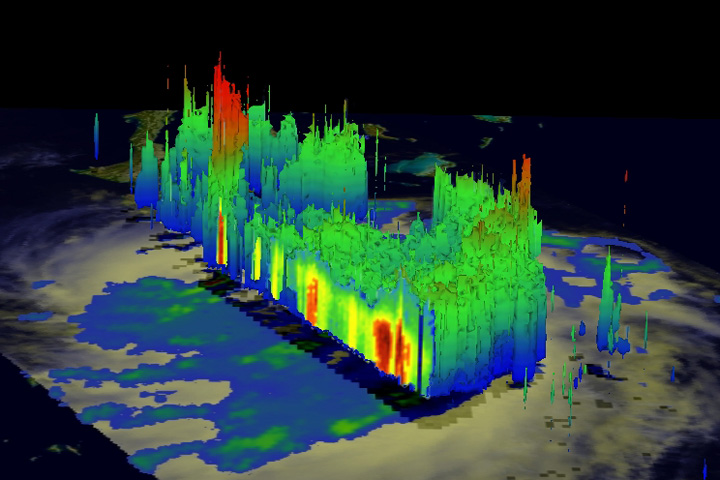
As Hurricane ‘Irene’ intensifies in the Caribbean, NASA offers this perspective revealing “an area of deep convection (shown in red) near the storm’s center where precipitation-sized particles are being carried aloft. These tall towers are associated with strong thunderstorms responsible for the area of intense rain near the center of Irene seen in the previous image. They can be a precursor to strengthening as they indicate areas within a storm where vast amounts of heat are being released. This heating, known as latent heating, is what is drives a storm’s circulation and intensification.” For more, click here here to be taken to NASA’s Earth Observatory.
Imperial Valley and Salton Sea
Posted on | August 22, 2011 | No Comments
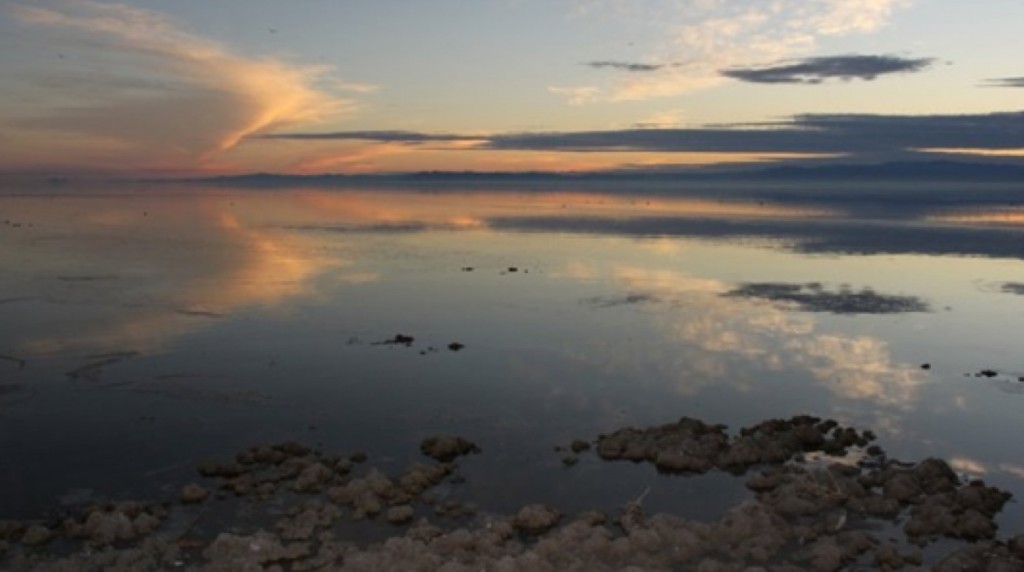
Salton Sea. Photo: Chris Austin / Maven's Manor. Click on the photo to be taken to Austin's collection of water education slide shows.
Not quite sure what happens to the lion’s share of the Colorado River? Chris Austin, web master at the Water Education Foundation’s newsfeed Aquafornia, moonlights as a producer of educational slide shows. Click here for part one of her latest project on the Imperial Valley and Salton Sea.
Three deserts and the fourth estate
Posted on | August 20, 2011 | 2 Comments
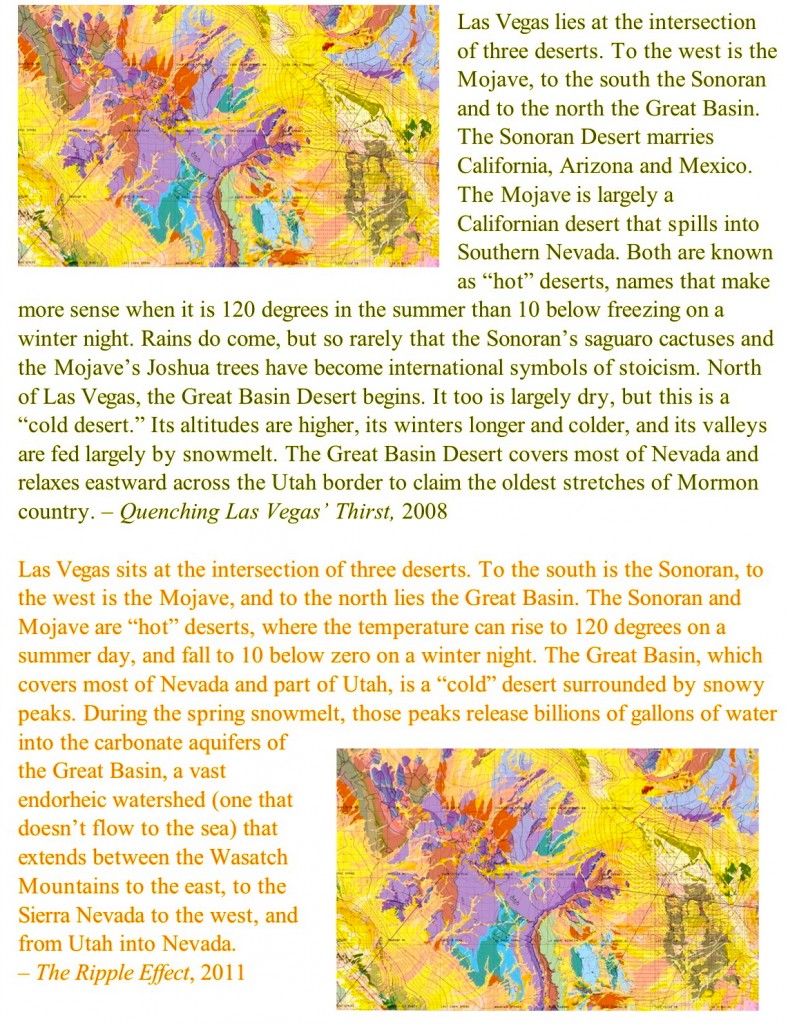
Perusing a new water book in Vroman's Bookstore in Pasadena last June, I found myself reading various passages (sample above) that were strikingly similar to descriptions from a series that I reported and wrote for the Las Vegas Sun in 2008. There was no right response and there were plenty of wrong ones. The story of which wrong ones I chose, along with some notes on intellectual property law as it applies to a steadily vanishing population of original reporters, is in today's Los Angeles Review of Books. Click on the comparison copy and maps to be taken to LARB. Map source: US Geological Survey.
Tags: chance of rain > Emily Green > Los Angeles Review of Books > Quenching Las Vegas's Thirst
The Dry Garden: Beware the foxtail
Posted on | August 19, 2011 | No Comments
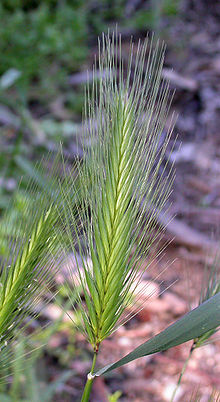
Foxtail: Hordeum murinum in Voorhis Ecological Reserve, Cal Poly Pomona. Source: Curtis Clark / Wikipedia
A romp with your dog in the garden or park should be a happy thing. Life affirming! Usually it is, until your dog encounters the wrong plant. Then it can swiftly become pain and suffering, first for the dog, then for your bank account. Inspired by a recent emergency room visit with a terrier after what seemed at the time like a picture-perfect Kodak moment in a meadow, this is what amounts to a pet owner’s Most Wanted list of plants that can harm dogs, which gardeners should remove and hikers should avoid.
Top of my list, and also the lists of veterinarian Nancy Kay and UC Davis weed scientist Joseph DiTomaso are foxtails. Depending on where you live, these might be one of a number of grasses with needle-like seed heads. After a spectacularly wet winter and a mild, unusually long growing season this year, these are still standing, and at their most deadly – ripe, dry and brittle. In other words, the seeds are primed to imbed themselves in your dog. In Southern California, DiTomaso names as common foxtail-type grasses wild barley (Hordeum murinum) and ripgut brome (Bromus diandrus).
Click here to keep reading about a pawful weed in this week’s Dry Garden column in the Los Angeles Times.
« go back — keep looking »
North American Native Plant Societies
After the lawn

Garden blogs
