Surrender Dorothy
Posted on | April 5, 2010 | 4 Comments

Abandoned buildings in Pioche, Lincoln County, Nevada. The county partnered with Vidler Water Co. out of the belief that this would protect its groundwater reserves from predation by Las Vegas. Instead, Vidler partnered with Las Vegas and a massive private developer. The benefit to towns like Pioche, other than sharing water revenue with Vidler, remains unclear.
Talk about Westerns: Over the weekend, Henry Brean of the Las Vegas Review Journal, dusted down a honey of a grudge match.
It’s in Nevada, and Nevada being the driest state in the union, it’s about water.
To the south, we have Patricia Mulroy, the blonde general manager of the Southern Nevada Water Authority, who formed her agency expressly around the idea of building a nearly 300-mile-long pipeline into the wild heart of the state to sustain otherwise impossible growth around Las Vegas.
To the north, there is the brunette. Dorothy Timian-Palmer, a former Carson City water manager, now president of the Vidler Water Company, is the face of a modern breed self-styled as “water developers.”
Click here to keep reading
Tags: chance of rain > Emily Green > Southern Nevada Water Authority > Vidler Water Co.
The Dry Garden: Eco-snooping, part two
Posted on | April 2, 2010 | 1 Comment
 It was a hybrid call of the wild that Gilda Garcia heard when she decided to do a native garden in the frontyard of her North Hollywood home in 2006. As she recalled it during a mid-March visit, “The challenge was how could you mix native plants, Mexican art and poodles?”
It would be a spoiler to use anything but a detail shot from what is a truly fabulous before-and-after photo spread put together by Garcia and Los Angeles Times photographer Anne Cusack for this week’s “The Dry Garden” column.
So, click here to see how Garcia transformed her garden from lawn and three hedges into “Poodleville” in the Los Angeles Times and to read the second installment of the three-part series previewing properties on the Theodore Payne Foundation Tour, April 10-11.
Weather from space turns 50
Posted on | April 1, 2010 | No Comments
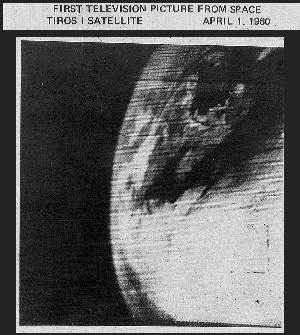 Fifty years ago today, the world’s first weather satellite lifted off from Cape Canaveral, Fla., reports the National Oceanic and Atmospheric Administration.
Not even a blown April Fools rain forecast for Los Angeles can suppress the jubilation at NOAA, which adds: “The first image from the satellite, known as TIROS-1 (Television Infrared Observation Satellite), was a fuzzy picture of thick bands and clusters of clouds over the United States. An image captured a few days later revealed a typhoon about a 1,000 miles east of Australia.”

TIROS-1, (NASA photo left) a polar-orbiting satellite that lasted 78 days, weighed 270 pounds and carried two cameras and two video recorders.
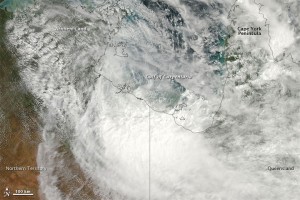
Below, as contrast, is a March 2010 NASA satellite image of Tropical Cyclone Paul, posted today at NASA’s Earth Observatory. This was taken by the Aqua satellite, launched in May 2002 as part of a project to better understand the Earth’s water cycle. Single click on the cyclone image to enlarge it.

Many thanks to meteorologist/blogger Bad Mom, Good Mom for the alert to the anniversary and whose website marks the occasion with a delightful essay on weather satellite orbits and watching.
This post has been updated. The Aqua image of Tropical Cyclone Paul was uploaded.
Tags: chance of rain > Emily Green > National Oceanic and Atmospheric Administration > satellites
High good, low bad: Mead in March 2010
Posted on | April 1, 2010 | 1 Comment
 There is a joke that my father, a former aerospace engineer, used to tell that applies equally well to water as to planes. There is a jolt on a jet and the pilot announces that the plane has lost one engine but still has three more. They will be a half an hour late landing. Soon, there is a second jolt and the pilot announces that another engine has failed, but they still have two engines and will be an hour late landing. After a third jolt brings the announcement that they still have one engine and will be an hour and a half late landing, an engineer from the cabin cries, “If the fourth engine goes, we’ll be up here all night!”
Water wise, in spite of a mild El Nino winter, it looks like the West may be up here all night. The level of Lake Mead, the major reservoir serving Southern California, Southern Nevada, Arizona and Mexico, continues to drop from a closing elevation in February of 1,103.21 to 1,100.66 at the end of March.
Click here for closing March elevations going back to 2002
Tags: chance of rain > Emily Green > Lake Mead elevations > US Bureau of Reclamation
Do I hear three dollars?
Posted on | March 30, 2010 | 3 Comments

Click on the checklist to be taken to the Long Beach lawn-to-garden program website
Las Vegas topped the regional cash-for-grass payout rate with $2 per square foot (now down to $1.50) until the City of Long Beach today announced that it will be offering $2.50 per square foot up to $2,500 for qualifying homeowners.
The calculus behind this sort of bribery is that it is cheaper for a Western water authority to pay homeowners to remove turf and replace it with a drought tolerant garden rather than for the city to vie with competitors for ever more water from an ever shrinking common pool.
Beyond the decision to increase the bounty on turf, what sets Long Beach’s program apart from, say, the cash-for-grass scheme launched by the City of Los Angeles last June is an enviable combination of conviction and competence.
While the City of Los Angeles sat on its hands during 2006-07, the driest rain year in Southern California history, Long Beach voted in strict watering ordinances. When in 2008-09, Los Angeles finally followed suit with watering ordinances and offered a cash-for-grass program of $1 per square foot, the incentive got lost in a Metropolitan Water District-sponsored phone system whose automated voice mail greeted visitors with news that all rebates had been canceled. Only those who hung on after being told to go away were eventually put through to an operator from the Los Angeles Department of Water and Power.
Meanwhile, Long Beach had moved on to sponsoring yard makeovers in each of its districts.
This year, the Long Beach program has expanded to a cash-for-grass program timed to coincide with local events designed to teach residents about replacement landscapes. These include the Long Beach City College plant sale on March 31-April 3 and the Theodore Payne Foundation Tour on April 10-11. For a look at some of the gardens on the tour, including two in Long Beach, click here (and groove on the fact that one is an apartment complex).
For a full listing of dry garden events around Southern California, click here.
This all begs the question as the Los Angeles Department of Water and Power fishes around for a new general manager, why can’t we have someone from Long Beach?
« go back — keep looking »North American Native Plant Societies

After the lawn

Garden blogs
