The Dry Garden: Vertical waste
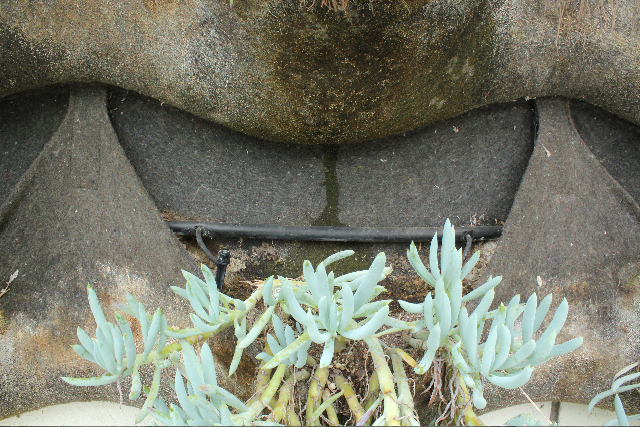
Detail of a "Woolly Pocket" (actually recycled plastic) at the SmogShoppe vertical garden in Culver City in summer of 2010. Normally drought tolerant succulents require routine irrigation in a mouldering setting. Photo: Emily Green
They say you catch more flies with honey than vinegar, but I’ve never wanted to catch flies. Moreover, as borrowed phrases go, I far prefer, “If you don’t have anything nice to say, sit by me.” And so, I issued an invitation: If you are skeptical about the vogue for vertical gardens, sit by me.
A few smart people from the worlds of gardening and landscape architecture took the chair. Here’s what they had to say.
Click here to keep reading this week’s ‘Dry Garden’ in the Los Angeles Times.
A comment string to do with this post has been removed because it was overpopulating the home page and descending in tone. The sentiments of the …
Arguing with drunks
Los Angeles City Hall on a foggy morning seen from the top floor of the DWP building. Photo: Emily Green. Click on the image to be taken to the City Council 'on demand' service to watch LA's politicians try to pass a lawn-watering ordinance.
Los Angeles City Council President Eric Garcetti yesterday encouraged colleagues to approve a 3-day-a-week lawn-watering ordinance while defending himself against criticism from a recent op-ed piece in the Los Angeles Times (written by me).
“There was an editorial or op-ed in the Los Angeles Times, it was well written, it argued that we shouldn’t go to 2-3 because it kills more plants,” he said. “If you actually look, there’s a lot of research on both sides and that is really more about grass only and certain types of grass. And even in the hottest hours, we know that if you only do it twice a week …
The week that was, 8/1-7/2010
“It is unprecedented …” — Major General Athar Abbas, Half a million evacuated from Pakistan floods, Daily Telegraph, August 6, 2010
“I appeal to the world to help us.” — Pakistani prime minister Yousuf Raza Gilani on floods now estimated to impact more than two million people, Rains worsen Pakistan flood misery, Al Jazeera, August 8, 2010*
Refugees from record monsoon flooding in Pakistan. Click on the image to make a donation to British Red Cross relief efforts. A £20 sterling donation will translate to roughly $32 US dollars.
“If we do not own the freshness of the air and the sparkle of the water, how can you buy them?” That’s an excellent question, but it turns out [Chief Seattle] never asked it. The entire “web of life” speech was concocted in 1972 by a Hollywood screenwriter. — H2Ownership: Ancient, Equitable Traditions of Efficient Water Resource Trading …
The Dry Garden: Choosing fruit
Central to the promise of the California dream is the idea that you can reach out of your kitchen window and pluck a lemon. As we hit the limits of our water supply, that specter of home-grown fruit remains steadily possible, even a social ideal in the complex matrix of energy and water footprints.

In attaining it, the first hurdle is choice: What kind of lemon? What about oranges and limes? A modest lot in Los Angeles can produce full loads of not only citrus but also avocadoes, plums, apricots and nectarines. And don’t forget figs, pomegranates and apples. A long list only becomes longer when you consider the varieties and crosses available for each type of fruit. Valencia orange or blood? Eureka lemon or Meyer? Plum or “aprium”?
Choice of fruit trees is one of the most important decisions that you’ll make in a garden. You’ll be eating the …
Prop 18 analyzed by The Pacific Institute
Click on the cover for a PDF file the Pacific Institute's analysis of Proposition 18, California's $11.1bn water bond
At the end of 2009, the California Legislature passed a series of water-related bills and at the same time approved a massive $11.14 billion bond [the “Safe, Clean, and Reliable Drinking Water Supply Act of 2010”] to fund a wide range of water projects and efforts. This is the largest water bond in 50 years, yet the costs and benefits of the bond have not been fully assessed by an independent organization. Until now, writes Pacific Institute president Peter Gleick in the San Francisco Chronicle.
This bond is to be voted on by California voters in November, as Proposition 18. The Governor recently proposed postponing the bond, but the Legislature has not yet taken the action required to have it pulled off of the November ballot.
Click here to keep …
« go back — keep looking »North American Native Plant Societies

After the lawn

Garden blogs
