The week that was, 1/17-23/2010
Huila, Angola. A boy jumps into a pool below a waterfall. Photo: Finbarr O'Reilly / Reuters. Click on the image to be taken to the original from The Guardian's "24-Hours in Pictures."
… “this slick and fluted glitter, / slightly / arcing, rebraiding itself as it falls, // as for tangible / seconds it’s a thin/ taut string of surface tension // that my hand feels, on the handle, / as a pulse, a pull, / a thing // in space, that lives in this world” — excerpt from “Pour,” a poem from The Water Table by Philip Gross, winner of the TS Eliot Prize for Poetry, reviewed by the Guardian, January 23, 2010
…
The Dry Garden: Native mallows
Few plants better connote the sheer luxuriance of the California dream as hibiscus. It comes from a clan of plants known as mallows native to the tropics, where, University of Texas botanist Paul A. Fryxell says, this family finds its “greatest richness.”

Fryxell is an authority on mallows, a family that he says has more than 100 genera with cousins around the world, capable of tolerating situations as diverse as the high climes of the Andes, hot and dry Palm Desert and the mediterranean climate of coastal California.
Talk to Fryxell and it soon becomes clear why hibiscuses in Southern California needn’t be a guilty pleasure, even though they’re tropical. Thanks to their robust root systems, many can go with only occasional deep watering during dry season. Once established, they are happiest when treated like trees.
For Californians, he also points to our native mallows. Those who haven’t expanded from …
Questions, anyone?
The House Natural Resources Committee, Subcommittee on Water and Power, led by Rep Grace Napolitano, will hold a public meeting Monday, January 25, 2010, at 1:00 pm at the offices of the Metropolitan Water District of Southern California, 700 N. Alameda Street, Los Angeles, CA 90012.
The theme is “Perspectives on California’s Water Supply: Challenges and Opportunities” and, to the Rep’s credit, there will be a whole lot of perspective in the house. Among the panelists will be the Commissioner of the federal Bureau of Reclamation Michael Connor, California Assembly Member Anna Caballero, director of the California Department of Water Resources Lester Snow, MWD General Manager Jeffrey Kightlinger, Imperial Irrigation District General Manager Brian Brady, San Diego County Water Authority General Manager Maureen Stapleton, Coachella Valley Water District Assistant General Manager Dan Parks, Pacific Institute president Peter Gleick, UC Irvine earth …
Bad planning and hyperbole
Photo: Bob Chamberlin / Los Angeles Times. Click on the image to be taken to the paper's storm photo gallery.
Contrary to forecasts, including the one repeated here, there were neither particularly heavy rains nor gales in Los Angeles yesterday. “I’m sympathetic with a blown forecast,” says Bill Patzert, an oceanographer with the Jet Propulsion Laboratory in Pasadena.
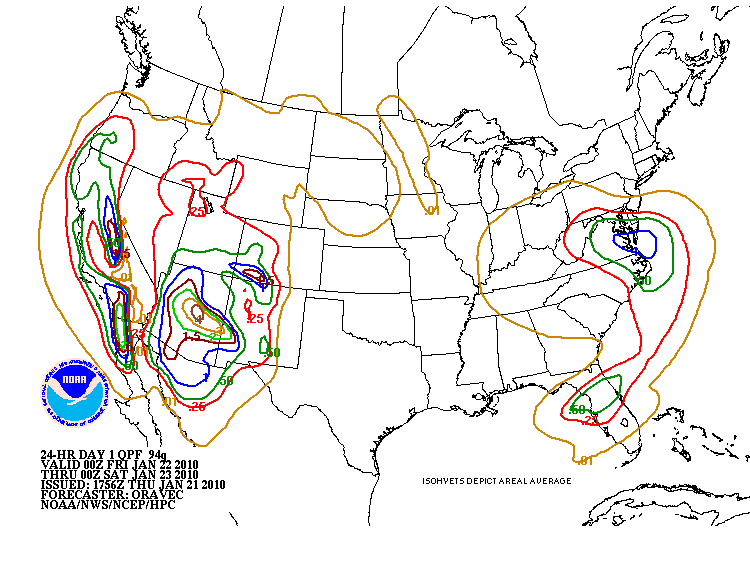
Having carried it, this writer is too, but only to a degree. It gives rain a bad name.
But when wrong news is good news, why gyp? Moreover, there is more good news in a place with such bad zoning that even the best-behaved showers throw the city into chaos.
As reported in The week that was, and repeated here for good measure, last week, the Los Angeles Board of Public Works passed a Low Impact Development Ordinance that will require new construction to retain more rain water on site …
Lawn’s carbon footprint

Amy Townsend-Small, UC Irvine, co-author of a new study comparing the carbon storage-versus-emission profile of Southern Californian lawns. Photo: Steve Zylius, UC Irvine
Smoking kills and lawn grooming contributes to global warming, reports the American Geophysical Union.
Actually, the AGU press release doesn’t talk about cigarettes, just grass: “Dispelling the notion that urban ‘green’ spaces [read lawn] help counteract greenhouse gas emissions, new research has found — in Southern California at least — that mowing and other lawn maintenance emit much larger amounts of greenhouse gases than the well-tended grass sequesters.
“Turfgrass lawns remove carbon dioxide from the atmosphere through photosynthesis and store it as organic carbon in soil, making them important “carbon sinks.” However, greenhouse gas emissions from fertilizer production, mowing, leaf blowing and other lawn management practices are four times greater than the amount of carbon stored by ornamental grass in parks,” a new study to be …
« go back — keep looking »North American Native Plant Societies
After the lawn

Garden blogs
