Expo Line plants: Think first, proselytize later
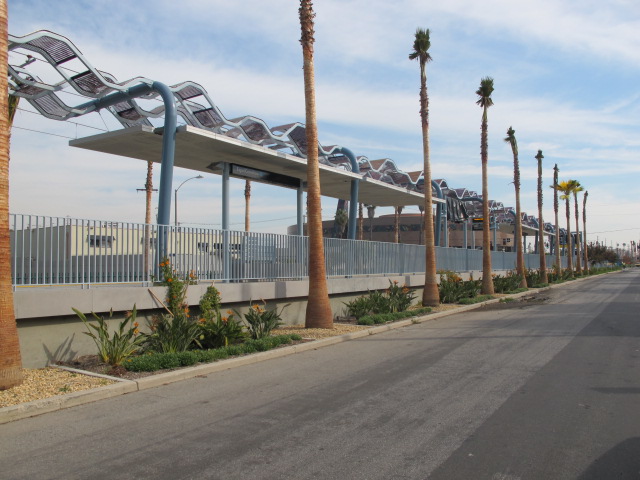
UPDATED Many of the same people whose passion and stamina forced Los Angeles City Council to adapt a low-water garden for City Hall are now campaigning for Phase Two stops of the city’s Expo Light Rail Line to be landscaped with native plants. Their movement, called LANative, has a website, a petition, and, most recently, support from an impassioned article in the Huffington Post.
Fellow travelers in the native plant movement, forgive me, but I can’t sing with the choir on this one. I can’t see how most of the powerful arguments for natives at City Hall to do with water efficiency, beauty, sense of place, pollinator benefit, run-off capture, leading by example etc. necessarily apply to a railway, which is less a garden setting than a fierce border twixt track and asphalt, steel and concrete.
In fact, …
High good, low bad: Mead in May 2012
Click on the cover to be taken to the "Aloud" program at the Los Angeles Public Library, where "Moral Ground" editor Kathleen Dean Moore will be part of a panel on western water on June 6, 2012.
Spoiler alert. It’s low bad for the monthly Mead report. The largest reservoir in the United States, which serves Southern California, Southern Nevada, Arizona, and Mexico, was at 1,119.38 feet at the close of May, 2012. That’s lower than it’s been for seven months, a mere 44 feet and change above a level that will invoke shortages in Arizona and Nevada. But! Now that doomsayers like me are all cheered up at any opportunity to remind wastrels with lawns, “We told you so,” it emerges that there is a more constructive voice in town. As clarification, it merits adding that the town is Los Angeles and the voice is that of philosopher …
God, lawn and me
#gallery-1 {
margin: auto;
}
#gallery-1 .gallery-item {
float: left;
margin-top: 10px;
text-align: center;
width: 33%;
}
#gallery-1 img {
border: 2px solid #cfcfcf;
}
#gallery-1 .gallery-caption {
margin-left: 0;
}
/* see gallery_shortcode() in wp-includes/media.php */

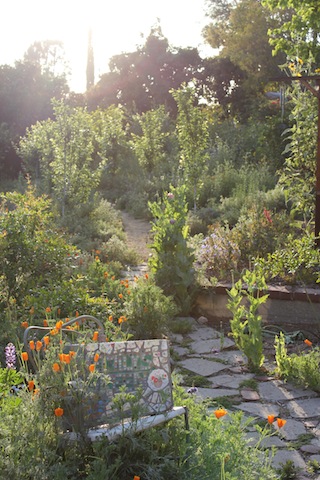

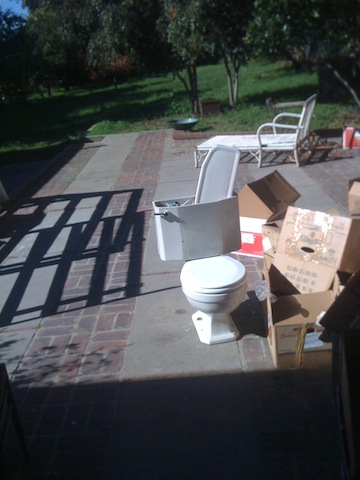
Sitting on the kitchen table is a rebate form from the local water company that I can’t bring myself to sign. Admittedly, a tidy slug of cash would be welcome for having replaced a toilet with an aquarium-sized tank with a low-flow version, and for having smothered and replaced a water-hungry backyard lawn with a mix of food and native plants that require a fraction of the water and provide many times the benefits. But even touching the rebate form feels corrupt. What kind of person expects to be paid for an act that is the opposite of sacrifice? …
More rock for LACMA, please
The Los Angeles County Museum of Art compares the Levitated Mass to the construction of the Pyramids. After captivating the world’s press by parading the 340-ton boulder from Riverside to mid-city Los Angeles last winter, the latest news is that the museum is about to officially declare its rock open for visitors. Irony of ironies, just as our collective gaze is once again drawn toward this $10m publicity stunt, roughly 20m cubic yards of the kind of rock that can’t be levitated has built up around the headwaters of LA’s paved rivers. In contrast to the Levitated Mass, it’s not getting much press while the infrastructure that holds it can and should rightly be compared to the Pyramids. This is the flood control system of 14 dams and 162 debris basins that form what historian Jared Orsi describes as “a Maginot line” between the San Gabriel Mountains and the …

Los Angeles built into a corner
LA’s improbable relationship with the San Gabriel Mountains makes the cover story High Country News: The list price was $1.125 million in August 2011, when Sotheby’s International Realty held the first open house for 1674 Highland Oaks Drive, in the Los Angeles suburb of Arcadia. Scented candles burned, classical music played and the air conditioner ran as potential buyers milled through the home’s three bedrooms, living room and combination den/dining room. Through sliding glass doors, a pool was visible in the rear garden; beyond it stood a sharply trimmed hedge. Past the hedge, in the ravine below it, a deep wash lay. Metropolitan Los Angeles ends at the edge of this canyon property, and above the wash, its steeply upland collar of national forest begins.
Once, like all the canyons threading the foothills of the San Gabriel Mountains, Santa Anita Wash had a stream tumbling through it, lined with coast …
« go back — keep looking »North American Native Plant Societies

After the lawn

Garden blogs
