News you can use
If it’s pictures of lovely native plants you’re after, go to the website of the Theodore Payne Foundation, which last weekend hosted a garden tour across greater Los Angeles. However, here and now, the story is about numbers. The City of Santa Monica has updated figures comparing the water consumption, labor requirements and green waste production of two side-by-side test gardens, one stocked with native plants and irrigated by drip and the other planted with a conventional complement of lawn and shrubs and watered with sprinklers. According to the project’s landscape designer Susanne Jett, since the two gardens were planted in 2004, the native one has used 81 percent less water, required 71 percent fewer hours of labor and produced 38 percent less green waste. Extrapolate those results across LA County’s roughly 1.6 million privately owned homes and it’s clear that one of the single most effective things …
Plus ça change, plus c’est la même chose

A new report from the NRDC is reminiscent of a Soviet-style Southern Nevada children's book praising Las Vegas water manager Pat Mulroy.
Publication this week of “Ready or Not: An Evaluation of State Climate and Water Preparedness Planning” by the Natural Resources Defense Council offers a good example of what happens when lobbyists are charged with assessing the very policy that they had a hand in developing. Las Vegas water manager Pat Mulroy becomes a climate hero and California becomes a nationwide leader in climate-ready water policy, a ranking prominently reported today in the San Francisco Chronicle.
Lest anyone mistake skepticism about the NRDC report as an endorsement of climate change denial, let it be said up front: Climate change is fact. What prompts this post isn’t any difference of opinion with the NRDC about the utter urgency of climate change preparedness, or even any over-arching …
High good, low bad: Mead in March 2012
The steady rise of Lake Mead, clearinghouse of Colorado River water for the Southwestern US and Mexico, was heartening while it lasted. From a November 2010 low only seven feet shy of triggering shortage declarations, a steady flow into the biggest reservoir in the US throughout 2011 pushed Mead’s elevation 58 feet above the austerity line.
However, in March 2012, the level began to fall again. Look at year-on-year figures from the federal Bureau of Reclamation and it is clear that since 2000 the overwhelming trend has been downward. The entire river system, including Mead, is only 63% of what Reclamation classifies as full.
If there is good news to be had in decline, and there is, part of it is that an innovative landscape architecture instructor at Cal Poly Pomona is tweaking the founding Reclamation mission to “make the desert bloom.” Charged with leading a sustainability studio this winter, …
Pacific coast irises: Look now, buy later
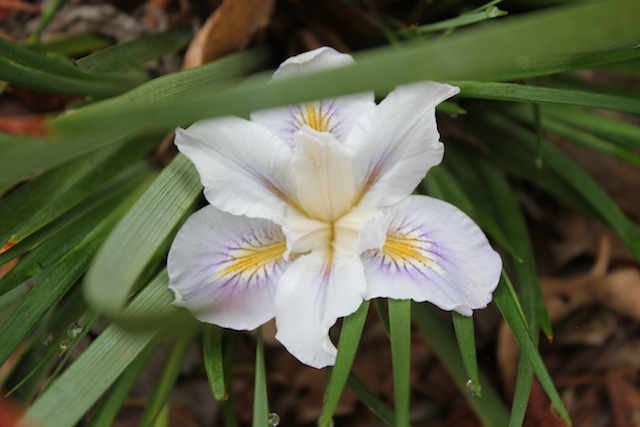
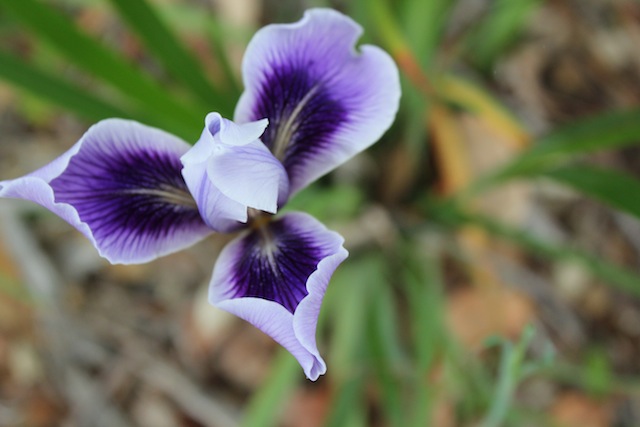
Last spring I wrote about how the March release by nurseries of Pacific coast irises tempted many — myself included — to plant the flowers in April. I put up this post-script because, having done it in 2011 after a wet winter leading into what proved a cool summer, I still saw mortality rates of 15%. Anyone trying it this April would be starting after a dry winter going into what looks like it’s going to be a hot summer. Here’s the problem: If you are watering newly planted irises as they become dormant in May and June, and given the only partially charged soil, you probably will be, it’s a perfect recipe for root rot and death. At $5 a plant, or more, there are much less dispiriting ways to waste money. So in these dewy days following our long-awaited rain, my advice is to inspect established Pacific coast …
Aroused by rain
The appearance of this mushroom after a much-needed rain in the Los Angeles foothills demanded that I Find The Camera. In the interim between putting the photo on Facebook this morning with a request for an ID and getting a response to an e-mailed query from Los Angeles County Natural History Museum mycologist Florence Nishida this evening, speculation as to its genus involved unbridled merriment. Southern California resident treasure, memoirist Erika Schickel, ventured that it was a Micropenisula shlongaeria. My own suspicion had been a Phallus anthonyweinerii. After more ribald speculation and some genuine mycological story-telling on the social network, Nishida’s response by e-mail in early evening had a “eureka” quality.
You are a lucky girl,” she wrote, “nature has gifted you with a stinkhorn, aka phalloid fungus. It’s probably Lysurus borealis, though another species is very common in southern California, Lysurus mokusin. Just looking at your …
« go back — keep looking »North American Native Plant Societies

After the lawn

Garden blogs
