High good, low bad: Mead in February 2011
Posted on | March 1, 2011 | 1 Comment
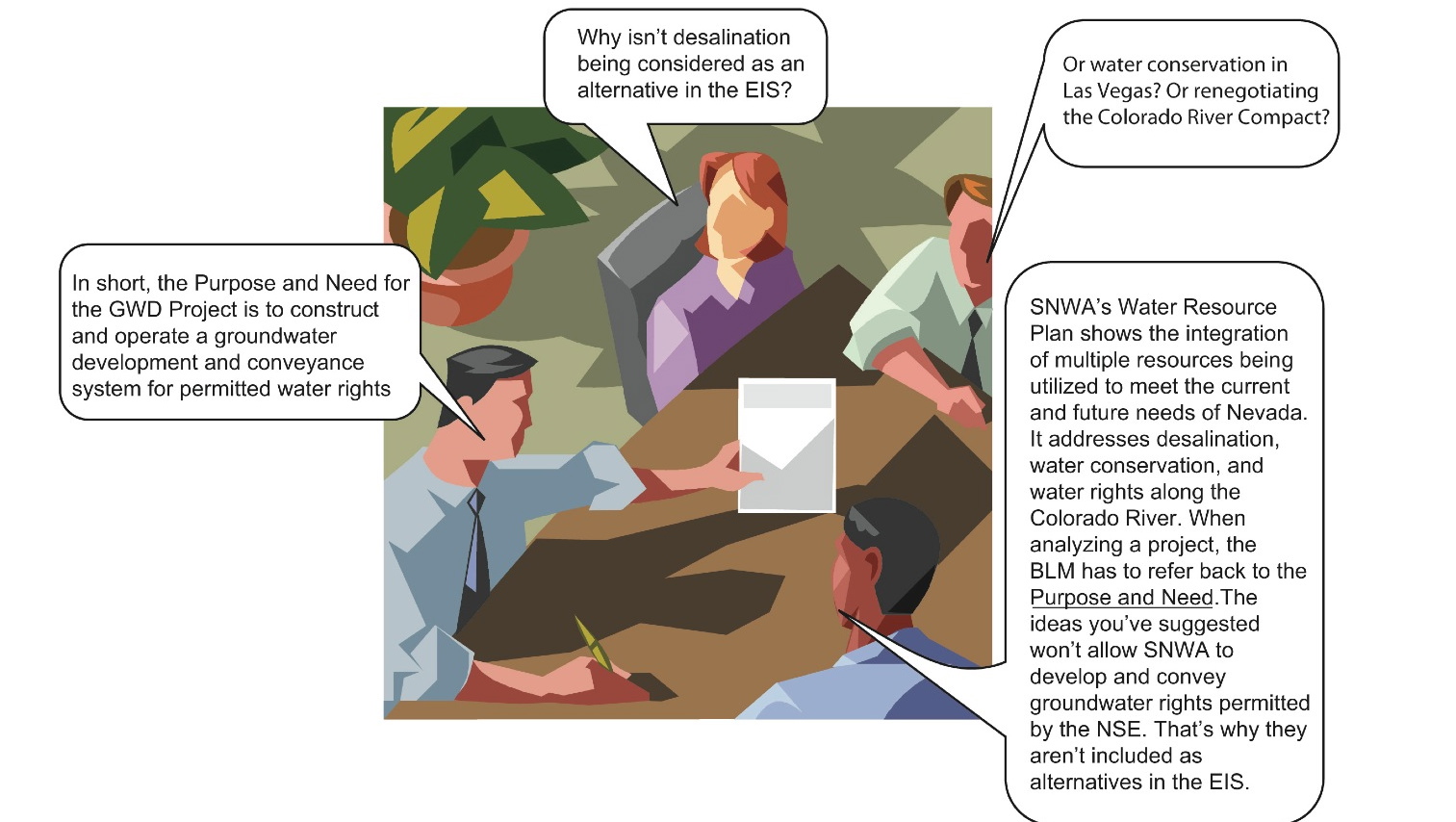
Actionful and remarkably well-groomed bureaucrats: Bureau of Land Management illustration explaining what might appear a Southern Nevada Water Authority-friendly bent in the framing of the pending Environmental Impact Statement. Click on the image to read the captions.
Two decades ago, a plan to tap the Great Basin Aquifer in five Nevada valleys through a nearly 300-mile-long pipeline to slake inexorably booming Las Vegas was a back-up plan. Plan A was that Nevada’s relatively small allocation from the Colorado River could be increased. Las Vegas is, after all, twenty miles from Lake Mead, the largest storage reservoir in the U.S.
Yet when Western cities kept booming after the Colorado River entered long-term drought in 1991, Plan B became Plan A. Tapping the aquifer of the glorious and sparsely populated counties of Nevada’s Great Basin Desert became a central pillar of the Southern Nevada Water Authority’s long term water plan. Steve Wynn’s and Kirk Kerkorian’s empires depended on it, and so did the livelihoods of a lot of casino workers enticed to the Mojave by the gaming industry.
It was not a moral plan, not an environmentally sound one either, but thanks to political heft it was working until cracks began appearing in the legal groundwork. In a series of court cases in 2009 and 2010, Las Vegas was stripped of its water awards from four rural basins. In one case, the State Engineer was found to have awarded water from three valleys without credible evidence that adequate supplies existed. In a further case covering every target valley, the State Supreme Court then found that the State Engineer had denied protestants their due process rights by allowing punishing delays in hearings.
Victory was bittersweet. The protestants didn’t win. Rather, they now get to fight a two decade-old war all over again. This week, the Great Basin Network, formed to fight claims first published in 1989, announced state-wide workshops to help rural Nevadans again go through the expensive and time consuming process of filing legal protests that will ensure them status in upcoming hearings. The first workshop begins Thursday in Las Vegas. Click here for details. The protest period will close March 24th. For a schedule outlining subsequent hearings, click here to be taken to the Nevada State Engineer. Click here to keep reading
Wet weekend
Posted on | February 27, 2011 | No Comments

Briefest of snow in Altadena, California, elevation roughly 1,400 feet, Saturday February 26th.
If you thought that Southern California’s much anticipated snow was the damp squib of the weekend, you didn’t watch the Oscars. More interesting are 2010-11 precipitation numbers to date for what has been a reasonably wet rainy season in Los Angeles County in spite of a La Niña in the equatorial Pacific.
Foothills: Altadena 26.89″ ***, Pasadena: 15.58″ *
San Fernando Valley: Burbank: 14.09″ **
Basin: Downtown Los Angeles: 15.78″ **
Coast: Long Beach: 15.38″ **
If luck amounts to a water plan, then we planned well. To see how a now weakening La Niña has impacted the southern US, from Arizona clear across to Florida, click here for the US Drought Monitor.
*Source: National Weather Service, Los Angeles/Oxnard
**Source: National Weather Service, California Nevada River Forecast Center
***Source: Bill Westphal
On the public record
Posted on | February 25, 2011 | No Comments

Myself I planted native plants because I couldn't afford a sprinkler system when I first moved to Southern California. Then of course I became sanctimonious about it. The bees were pure gravy.
On the public record, the most smartly written blog on California water, responded yesterday to the publication earlier this week of the Public Policy Institute report Managing California Water: From Conflict to Reconciliation, “Reconciliation? Reconciliation of what? Northern and southern Californians? People living in regions that are about to get screwed with their fates? People and the new Californian dream?
Oh. Environmental and Human Water Uses, apparently. That’s a pretty boring thing to reconcile, because what matters in a political system is people’s expectations and their subjective experiences. Do they feel like they’re having their god-given American right to red meat at every meal yanked away from them, or do they feel like they’re planting native plants because they love the bees so much? The report says fuck-all about how to get people to buy into this, and so will the Delta Plan and so will the Flood Plan and so will every other state level document ever on the face of the earth because they don’t consider people and their feelings as knowable important components of what happens.”
Click here to keep reading Otpr. Hat tip Aquafornia.
Tags: chance of rain > Emily Green > On the public record blog > Public Policy Institute
The Dry Garden: Fremont’s flower
Posted on | February 25, 2011 | 1 Comment

Some years ago, the website of Native Sons Nursery had a photograph of a California flannel bush that had been trained to grow along a garden wall. Each bloom in a spangle of flowers was the size of a tea cup. Their yellow could outshine a daffodil, or sunflower. This wasn’t a garden, it was a garden that Matisse dreamed. On seeing that photo, so began years of looking in Los Angeles area gardens for espaliered examples of the glorious genus of natives whose botanical name is Fremontodendron.
And never finding one.
It turns out that the photograph was taken in Guernsey by Native Sons co-founder David Fross, who had just left a place that serves alcohol when he saw the glorious display by one of the signature plants of California chaparral growing in one of the Channel Islands between Britain and France. “I’d had two martinis and half a bottle of wine, came around the corner and late evening light was crashing into this yellow door. At first I was staring at the door. Then I focused and said, that’s Fremontodendron.” It ran almost 50 feet along a wall.
Click here to keep reading this week’s ‘The Dry Garden’ in the Los Angeles Times.
Waiting for ‘catastrophe’
Posted on | February 24, 2011 | No Comments

"Today’s system of water management, developed in previous times for past conditions, is leading the state down a path of environmental and economic deterioration. We’re waiting for the next drought, flood, or lawsuit to bring catastrophe,” says Ellen Hanak, senior fellow at the Public Policy Institute of California and co-author of the new report Managing California's Water. "But if we take bold steps now, we can move from an era of conflict to one of reconciliation, where water is managed more flexibly and comprehensively, to benefit both the economy and the environment.” Click on the cover to be taken to the report.
North American Native Plant Societies

After the lawn

Garden blogs
