Sacramento all-nighter produces an $11.1bn package of water bills
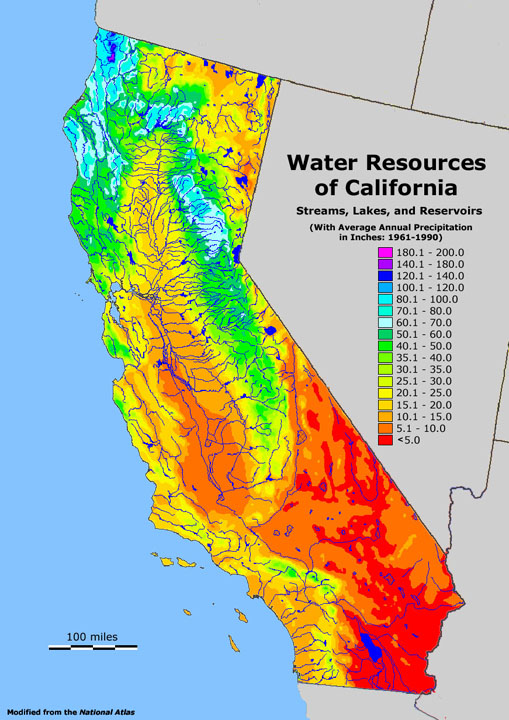
The California Legislature passed a wide-ranging water package that includes an $11-billion bond as dawn broke over the Capitol today, reports the Los Angeles Times.
In and Out:
In: 20% voluntary conservation by 2020 by urban areas not farms.
In: a bond measure that started at $12bn, dropped to $9bn then rose again to $11.1bn.
In: $3bn worth of dams demanded by the governor under threat of veto.
In: $2.25bn for Delta restoration and a board to oversee the Delta appointed by the governor and legislature. This would have the power to approve a peripheral canal to channel water around the Delta.
Out: Groundwater monitoring for privately owned properties. The stick, reports the LA Times “is a loss of water funding. Counties and agencies in groundwater basins that didn’t monitor could not receive state water grants or loans.”
Out: Increased penalties and increased enforcement to control illegal water diversion.…
Westlands
AS STAGE armies work Sacramento for their pieces of a proposed $9 plus billion water bill and bond, attorney Lloyd G. Carter would have us wipe some tears from our eyes about the plight of Westlands Water District.
Carter, a former UPI and Fresno Bee reporter, now a deputy in the California Attorney General’s office, has a new article on the subject in the Golden Gate University Environmental Law Journal.
He writes of Westlands in Reaping Riches from a Wretched Region: “federal irrigation and farm-subsidy policy in the San Luis Unit since the 1960s has exacerbated grinding poverty while enriching a few dozen of the factory farming dynasties to the detriment of the environment, the human population of the region, small growers, and the public fisc. There are few farms under 500 acres. Rule is by the rich. Indeed, in Westlands, which is a public agency, the …
“One earthquake, one flood away from collapse”
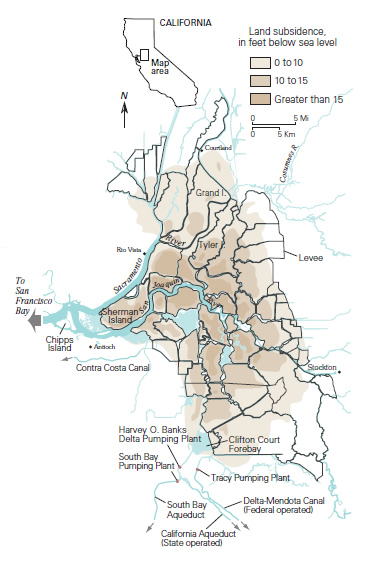
THE SACRAMENTO-San Joaquin River Delta is “one earthquake, one flood away from collapse,” said the California Senate speaker pro Tem as he opened legislative hearings last week on a compromise package of water bills. In case listeners didn’t care, Darrell Steinberg added to a legislature convened in an extraordinary session precisely to deal with the delta, “24m people could lose their drinking water.”
Powerful language, except in California extreme warnings are old hat. Delta levees have been crumbling for a quarter of a century, and repeated alerts to the clear and present danger, such as the USGS subsidence map, left, have not broken the deadlock between legislators representing fisheries, Delta residents, Central Valley farmers, and Southern Californian cities over how to manage the largest estuary on the Pacific coast of the US.
Latterly, a governor top-loading delta fixes with demands for $3bn worth of new dams has only deepened divides.…
The week that was, 10/25-31/2009
“What’s in a name?” — Bert Webber, Bellingham, Washington biologist, “State board adds Salish Sea to region’s watery lexicon,” Seattle Times, October 30, 2009
Los Alamos legacy
FRANK CLIFFORD, author of “The Backbone of the World,” long-time staff environment editor of the Los Angeles Times and now a freelance writer based in Santa Fe, New Mexico, reports in today’s Los Angeles Times on a threat from the Los Alamos National Laboratory to the Rio Grande. From the story:
Isolated on a high plateau, the Los Alamos National Laboratory seemed an ideal place to store a bomb factory’s deadly debris. But the heavily fractured mountains haven’t contained the waste, some of which has trickled down hundreds of feet to the edge of the Rio Grande, one of the most important water sources in the Southwest. Click here to keep reading.…
« go back — keep looking »North American Native Plant Societies

After the lawn

Garden blogs
