The week that was, 12/13-19/2009
Posted on | December 20, 2009 | No Comments
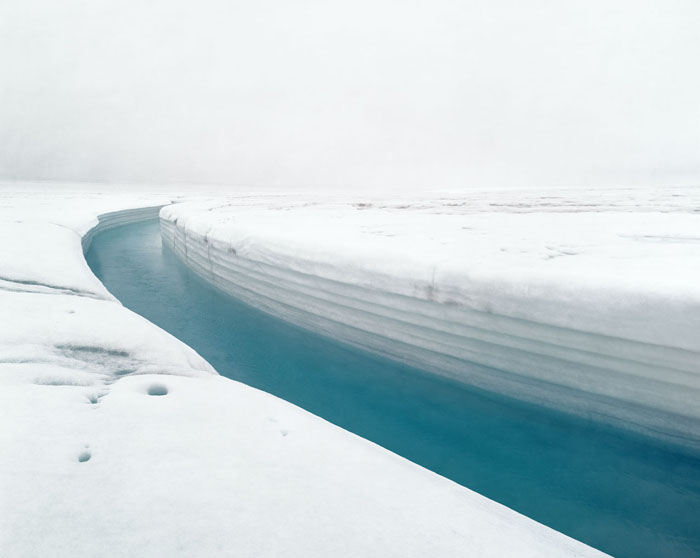
"River 2, Position 4," July 2008. Photo: Olaf Otto Becker from "Above Zero" at the Amador Gallery in New York through January 9, 2010. Click on the image to be taken to the gallery website and other images of the summer rivers of Greenland.
These pictures are … about the rivers of meltwater that form on the surface of the glaciers in Greenland during the summer. In the summer heat, the ice melts, and the little rivulets flow into bigger and bigger streams until eventually they become rivers. The water is a deep aquamarine. It wends its way through a landscape of white ice with blue tints, and of small black holes formed by atmospheric soot. The sky is crowded with low-hanging white clouds and only occasional breaks of blue or gray. There are no trees or telephone poles or anything, really, to give a sense of scale. How wide is the stream in River 2, Position 4? There is no way of knowing. Whether narrow or wide, it flows serenely around a bend, a fairy river in a fairytale land. — Portraits in dignity, the Wall Street Journal, December 19, 2009
Click here to keep reading The week that was
The Dry Garden: “The tree rings’ tale”
Posted on | December 18, 2009 | 1 Comment
 As the United Nations Climate Change Conference concludes in Copenhagen, what is a smart kid to make of the riots? That we’re all going to die — Santa first? That in a few years down the road, discussion of climate is best had wearing a clown’s nose while taunting a Danish policeman?
Let’s hope not. Let’s dream instead that winter solstice on Monday marks brighter days ahead in which the next generation may be armed with the best knowledge of what climate change means and what can be done about it.
And, eh presto, an ideal volume is at hand. A newly released book aimed at young teens, “The Tree Rings’ Tale: Understanding our Changing Climate,” is the work of science writer John Fleck. Although there are other texts out there for children, what sets Fleck’s book apart for Californians is its emphasis on the West. It’s particularly relevant to kids who experience nature in irrigated California gardens, taking them beyond the hose, the reservoirs and the aqueducts to explain the natural systems of the dry West that headlines tell us are under such dire threat. Click here to keep reading this week’s installment of The Dry Garden in the Los Angeles Times.
Tags: chance of rain > Education > Emily Green > water and climate
Final day. Yes we can / No we can’t
Posted on | December 18, 2009 | No Comments

A pelican huddles in a London zoo after a freak snow storm blankets England, including the normally temperate south coast, during the final days of the UN Conference on Climate Change in Copenhagen. Click on the image to be taken to the London Guardian for full photo coverage of the blizzard and the wan final day of the climate conference.
The Resnick touch
Posted on | December 17, 2009 | 3 Comments
 THE National Academy of Sciences today announced the constitution of an expert committee to review protections afforded fish covered by the Endangered Species Act in the Sacramento-San Joaquin River Delta, including Chinook salmon, Delta smelt and green sturgeon.
The assembling of these learned souls at the behest of US Senator Dianne Feinstein and California’s billionaire farming couple Lynda and Stewart Resnick brought to mind an incident that perfectly describes the reach of the Resnicks into institutions that we the people might fondly imagine to be incorruptible.
Click here to keep reading
Tags: chance of rain > Dianne Feinstein > Emily Green > Stewart and Lynda Resnick
The future of forests
Posted on | December 16, 2009 | 1 Comment

Giant Sequoias at Redwood Mountain, Kings Canyon National Park, CA, in the largest grove of this species. Photo courtesy of John Evarts, Cachuma Press
Ronald M. Lanner has explored the forests of the Western United States for 50 years. In the course of this, and in devoting five of his six books to the region’s trees, he has revealed that no where else on the planet has the same diversity of conifers, be it the oldest (bristlecone pines) or the tallest (redwoods) or the biggest (sequoias).
So Chance of Rain asked environment reporter Ilsa Setziol to interview Lanner on the future of the region’s timbered ranges in the face of climate change. Her discussion with the author of “The Pinon Pine,” “Trees of the Great Basin,” “The Conifers of California,” “Made for Each Other: A Symbiosis of Birds and Pines,” and “The Bristlecone Book” is not just for those who love trees, but for all who have experienced a moment of awe and wonder in a Western forest.
Update: For the December 1, 2009 paper, “Recent unprecedented tree-ring growth in bristlecone pine at the highest elevations and possible causes” by Salzer et al, vol. 106, no. 48 20348-20353, Proceedings of the National Academy of Sciences, click here.
Tags: chance of rain > conifer forests > Ilsa Setziol > Ronald M. Lanner
North American Native Plant Societies
After the lawn

Garden blogs
