“One earthquake, one flood away from collapse”
Posted on | November 2, 2009 | 1 Comment
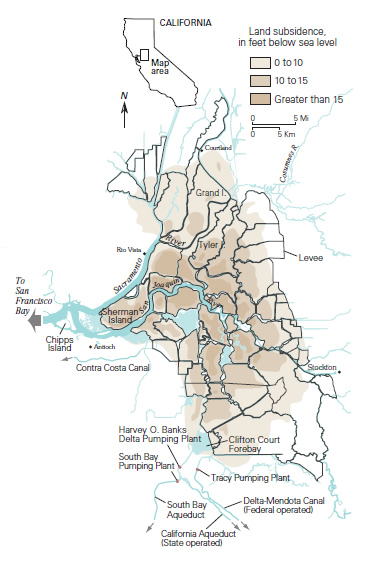
THE SACRAMENTO-San Joaquin River Delta is “one earthquake, one flood away from collapse,” said the California Senate speaker pro Tem as he opened legislative hearings last week on a compromise package of water bills. In case listeners didn’t care, Darrell Steinberg added to a legislature convened in an extraordinary session precisely to deal with the delta, “24m people could lose their drinking water.”
Powerful language, except in California extreme warnings are old hat. Delta levees have been crumbling for a quarter of a century, and repeated alerts to the clear and present danger, such as the USGS subsidence map, left, have not broken the deadlock between legislators representing fisheries, Delta residents, Central Valley farmers, and Southern Californian cities over how to manage the largest estuary on the Pacific coast of the US.
Latterly, a governor top-loading delta fixes with demands for $3bn worth of new dams has only deepened divides.
Click here to keep reading
Tags: California > chance of rain > Legislation > Sacramento-San Joaquin River Delta
The week that was, 10/25-31/2009
Posted on | November 1, 2009 | 1 Comment
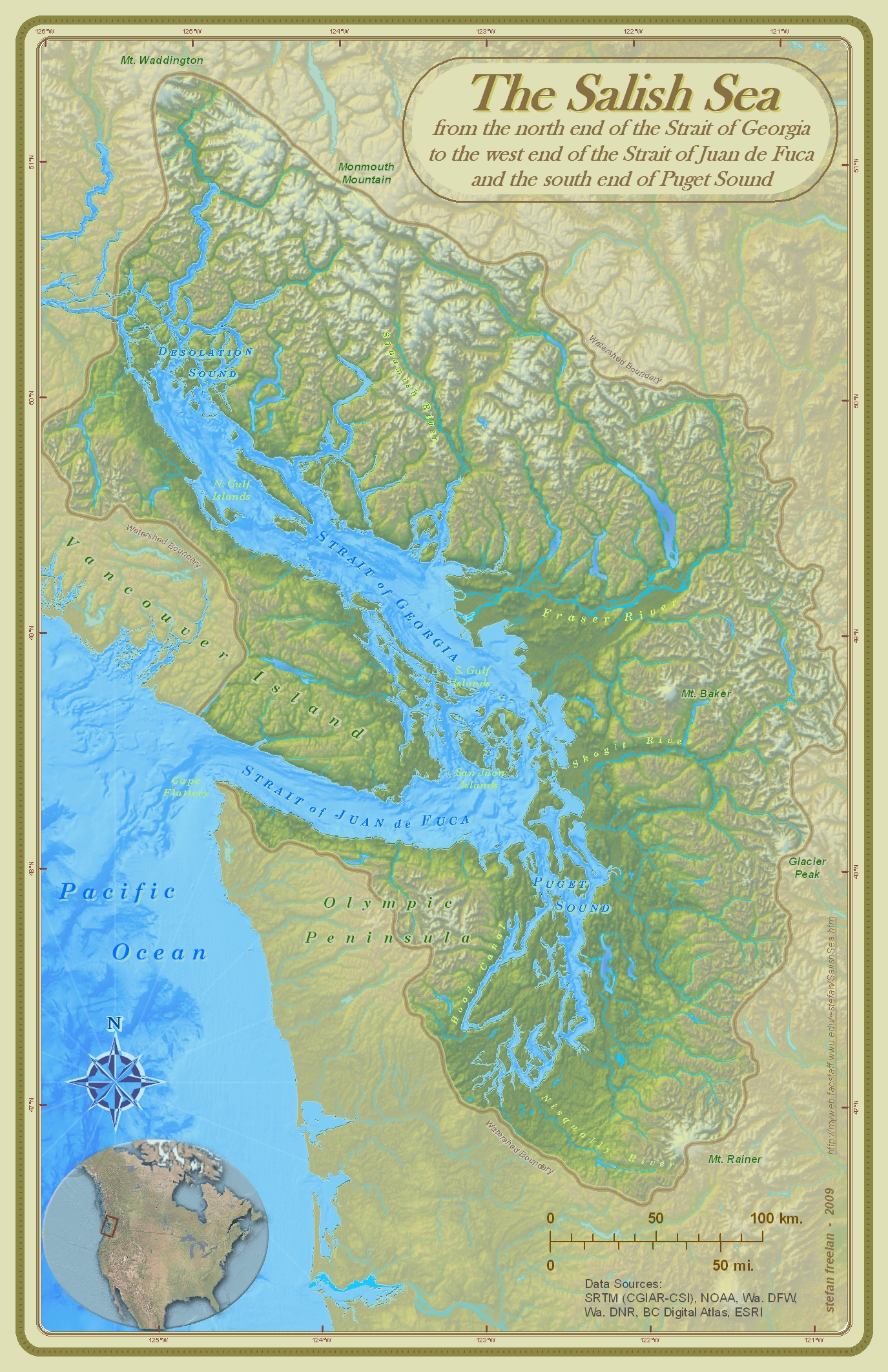
Salish Sea map by Stefan Freelan. Click on the image for the cartographer's notes.
“What’s in a name?” — Bert Webber, Bellingham, Washington biologist, “State board adds Salish Sea to region’s watery lexicon,” Seattle Times, October 30, 2009
Click here to keep reading The week that was
Los Alamos legacy
Posted on | November 1, 2009 | No Comments
 FRANK CLIFFORD, author of “The Backbone of the World,” long-time staff environment editor of the Los Angeles Times and now a freelance writer based in Santa Fe, New Mexico, reports in today’s Los Angeles Times on a threat from the Los Alamos National Laboratory to the Rio Grande. From the story:
Isolated on a high plateau, the Los Alamos National Laboratory seemed an ideal place to store a bomb factory’s deadly debris. But the heavily fractured mountains haven’t contained the waste, some of which has trickled down hundreds of feet to the edge of the Rio Grande, one of the most important water sources in the Southwest. Click here to keep reading.
High good, low bad: Mead in October
Posted on | November 1, 2009 | 3 Comments
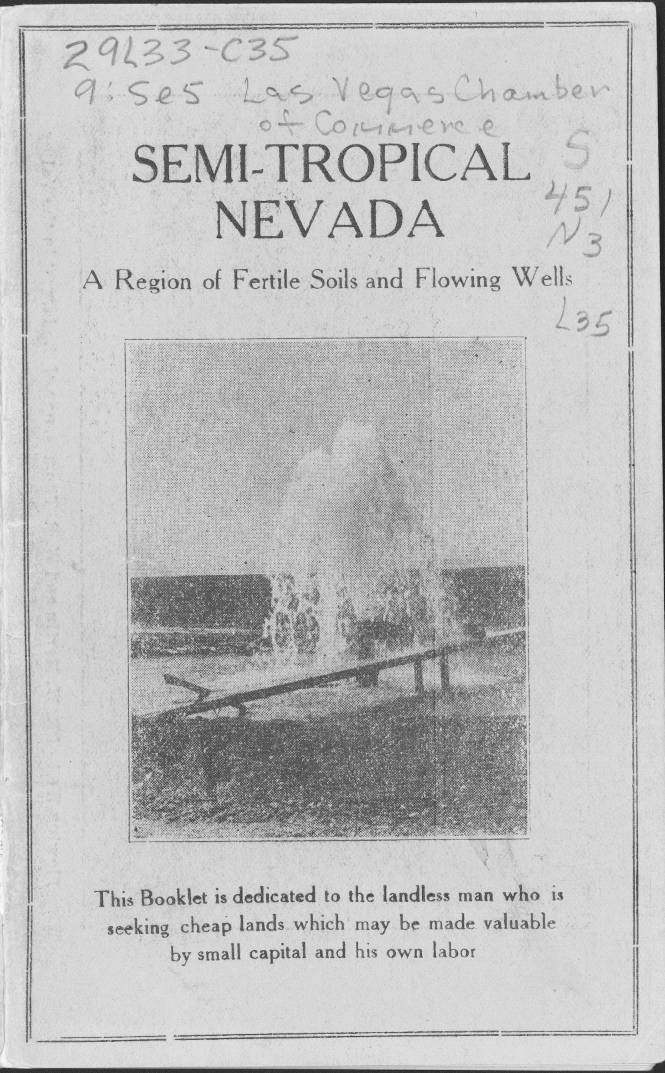
Source: University of Nevada, Las Vegas, Digital Collections.
WHEN the Colorado River’s water was divided by treaty in the 1920s, Nevadan negotiators never imagined that Las Vegas would need more than 300,000 acre feet of water a year (compared to Arizona’s 2.8m and California’s 4.4m). The population of Clark County was roughly 2,500. Its largest city, Las Vegas, a railroad town, already had groundwater and native springs, if not the semitropical climate promised in this Chamber of Commerce brochure, date unknown.
The once ebullient springs of Las Vegas are now dry, Clark County is 90% dependent on that 300,000 acre feet of water from Lake Mead, the reservoir containing Colorado River water impounded behind Hoover Dam. The population of greater Las Vegas is roughly two million and cities such as San Diego, Phoenix and Los Angeles also vie for water from water in Lake Mead.
Meanwhile, Mead is shrinking.
Click here for the October 2009 closing elevation of Lake Mead
Tags: chance of rain > Emily Green > Lake Mead > October 2009 elevations
Western datebook: the Green River
Posted on | October 30, 2009 | 2 Comments
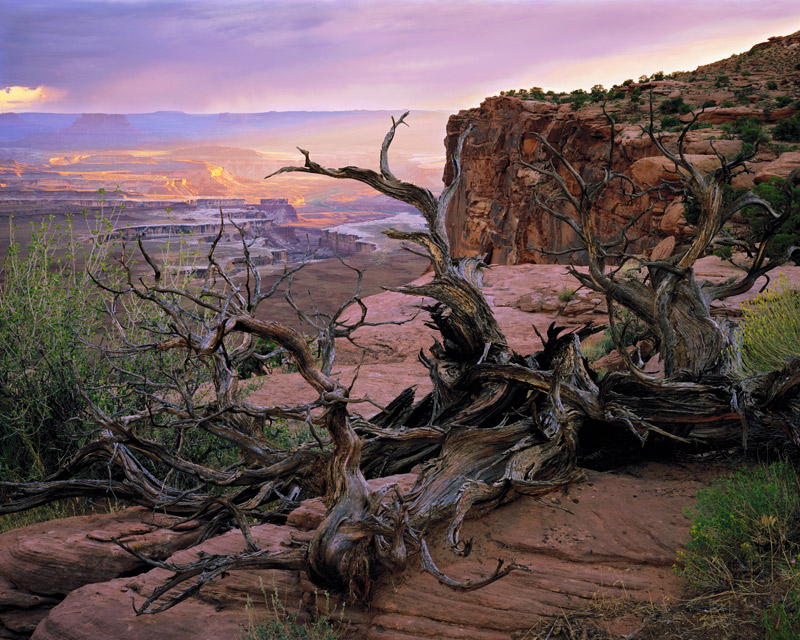
THIS PHOTOGRAPH by Robert Turner of a storm over the Green River in Canyonlands National Park, Utah, will be on display for one more week as part of the “Rare Places in a Rare Light” exhibit at the G2 Gallery in Venice, California.
Meanwhile Nancy Green’s documentary “Green River: Divided Waters” will air on Utah’s PBS station KUED, on November 9th and again November 15th.
Via the Great Basin Water Network.
« go back — keep looking »North American Native Plant Societies

After the lawn

Garden blogs
