The week that was, 6/21-27/2009
Posted on | June 28, 2009 | 1 Comment
- “There are lots of ways to lose an audience with a discussion of global warming, and new ones, it seems are being discovered all the time.” From “The Catastrophist,” Elizabeth Kolbert’s New Yorker profile of NASA scientist James Hansen
- “Eli Raz was peering into a narrow hole in the Dead Sea shore when the earth opened up and swallowed him.” AP / Denver Post on Dead Sea sinkholes
- Water seeping through Howard Hanson Dam is picking up speed … the Army Corps of Engineers doesn’t know why. Seattle Times
- “The Sacramento politicians are at it again. They’re back to try and take your water softener away.” Savemysoftener.com ad aimed at scuttling California Assembly Bill 1366.
- “It’s hyperbole. Clearly, it’s a very reckless and irresponsible attempt to engender fear…” Assemblyman Mike Feuer (D-Los Angeles), author of AB 1366, Los Angeles Times.
- “We cannot put off the future.” Nancy Pelosi taking the House floor after the failure of an attempted filibuster of the American Clean Energy and Security Act (aka Climate bill, Global Warming Bill, etc)
- “There is a very good chance that the severity of the water shortage Pasadena may experience will prove far more severe than you expect.” Oral presentation before Pasadena City Council on water rates by Cal-Tech trained engineer David O. Powell. From Pasadena Sub Rosa via Aquafornia
- “All I can say is No! No! No!” a Portland Oregonian reader responds to Nestle Waters North America’s proposal for a $50 million bottling plant in Cascade Locks.
- The Imperial Irrigation District found particular fault with an Imperial County Civil Grand Jury’s use of the word “corruption.’” In its report the jury also asked for responses to issues raised in two previous civil grand jury investigations conducted in the 1990s. … In its response the IID admitted its apparent failure to respond to previous civil grand jury reports but questioned the relevance of doing so more than a decade after the fact.” Imperial Valley Press via Aquafornia
- “We pay for levees and flood insurance, endure heavy rain and hot summers, and now meters and water fees so that people who live in the Southern California desert can have swimming pools and golf courses.” Sacramento resident writing to the Bee
- “The policies and guidance lack scientific foundation.” Scientific peer review of the US Army Corps of Engineer tree removal program on levees, reported by the Sacramento Bee
- “The idea of drinking water that’s been flushed down the toilet is a hard sell.” Maureen Cavanaugh, KPBS San Diego
- “Are they afraid we’re going to stop drinking their water?” Plan Nevada spokesman Launce Rake in Las Vegas CityLife questioning the need for the Southern Nevada Water Authority, a monopoly, to keep lobbyists in Salt Lake City, Washington D.C., Carson City and Las Vegas.
- “We’re trying to manage this water district so it doesn’t go into bankruptcy.” Elsinore Valley Municipal Water District Director John Lloyd in explaining steep rate hikes. North County Times via Aquafornia
- “The State Water Project was designed as a magnificent piece of work. Engineers knew there would be big problems using the Delta as part of the SWP infrustrucrture, so they included a channel in the original design to carry water around the Delta. But politicians said it was too expensive, so they used the Delta in spite of the engineers. This penny-wise and pound-foolish decision has resulted in the catastrophe we have today” Anonymous blogger, Sacramento Bee
- “The assumption is that anything that departs significantly from normality is an abnormality, and abnormalities at least have the potential for having deleterious effects.” David M. Checkley of the Scripps Institution of Oceanography at the University of California, San Diego on the discovery that fish in acid waters have bigger ears
- Thanks to the Bush administration’s industry-friendly rulings and a Supreme Court determined to ignore the plain language of the Clean Water Act, America’s waterways are at risk of becoming industrial dumps. The latest indignity was a 6-to-3 decision on Monday that will allow an American gold mining company to discharge 210,000 gallons a day of potentially toxic mining waste into a 23-acre lake near Juneau, Alaska. A joyous Sarah Palin, Alaska’s governor, called the ruling a “great victory” for Alaska and, astonishingly, “a green light for responsible resource development.” New York Times editorial on the Supreme Court Decision Coeur Alaska vs Southeast Alaska Conservation Council et al
Tags: chance of rain > Emily Green > headlines > The week that was
Weekly Drought Map
Posted on | June 25, 2009 | No Comments
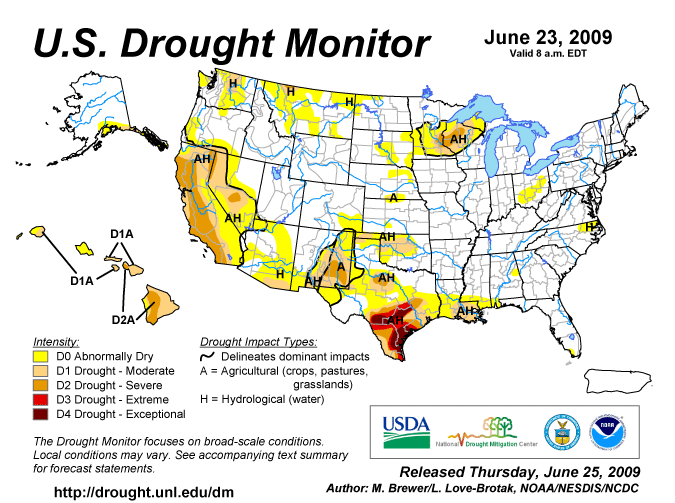
Click on map for link to the National Drought Mitigation Center
The Dry Garden: Watering native plants in summer, or not
Posted on | June 23, 2009 | 1 Comment
WHILE most Southern Californian gardens require more water in summer, native gardens need less. In fact, they take so much less that if you haven’t watered a native plant to death, then you probably haven’t tried native gardening. It’s a rite of passage, closely followed by the second rite of withholding all summer water — and killing the plant that way.
This is not to suggest that native plants are hard to grow. They’re just easy to kill. The key to reaping their beauty and benefits without watering them to death is understanding summer dormancy.
For the rest of the story in this week’s Los Angeles Times column The Dry Garden, click here.
Mixed message to mining: Clean up, says Obama Cabinet. Mess up, says Bush-era Supreme Court
Posted on | June 23, 2009 | 1 Comment
IT’S AS SCREWY as it sounds.
On Monday, in a 6-3 vote, the US Supreme Court upheld the legality of dumping gold mine waste into Lower Slate Lake in Alaska’s Tongass National Forest instead of disposing of it in a special tailings pond. The next day, the Agriculture Secretary announced nearly $20m dollars of federal stimulus funds to be spent on mine waste clean-ups, including $2.8m to Alaska. Meanwhile, the Clean Water Act in any of its various guises does not apply to the Alaskan lake about to receive 4.5 million tons of highly contaminated mine tailings.
First to the Supreme Court decision:
“The ruling clears the way for as much as 4.5 million tons of mine tailings — waste left after metals are extracted from the ore — to be dumped into the lake,” reported the Associated Press.
Not all of the justices were behind it. AP reported further:
“In a dissenting opinion, Justice Ruth Bader Ginsburg said it is “neither necessary nor proper” to interpret the waterway protection law “as allowing mines to bypass EPA’s zero-discharge standard by classifying slurry as fill material.” She argued the lower court had been correct in concluding that the use of waters as “settling ponds for harmful mining waste” was contrary to the federal Clean Water Act.
From the Sierra Club, which helped bring the suit, director Carl Pope today explained the history of the case and the difference between “fill material” and toxic waste this way:
“The Court ruled yesterday that as long as a pollutant contains enough solid material to reduce the size of a lake or river, it is not a pollutant, is outside the jurisdiction of the EPA, and can be reviewed only by the Army Corps of Engineers.
The case in point was the Kensington Gold Mine in Alaska, whose operators, Coeur Alaska Inc., want to dump all of its mine tailings into pristine Lower Slate Lake. This was not the original plan filed by the mine owners — their original tailing disposal plan kept the waste on land. But when the Bush administration changed the definition of “fill” under the Clean Water Act to make life easier for mining companies, Coeur Alaska decided it would be cheaper and more expedient to dump all4.5 million tons of its waste in Lower Slate Lake in the heart of the Tongass National Forest. The 9th Circuit Court had said “not so fast” and voided the permit. Pollution, the judges said, does not stop polluting just because it also fills up the lake.
Now comes the Supreme Court to rule, 6-3, that the Bush administration was within its rights to redefine pollution so that nothing solid can, by definition, be a pollutant. The mischief this opens up is almost incomprehensible — the first step in most pollution-control technologies is to separate out the solid stuff, so you can clean up the liquids before releasing them. Now polluters can merely skip that first, cheapest step and, voila, they’re no longer required to get a water-pollution permit!”
Meanwhile, in what seem like strongly related stories, the Senate Environment and Public Works Committee voted 12-7 late last week to advance the Clean Water Restoration Act, which now faces consideration by the full Senate, and Agriculture Secretary Tom Vilsack announced today $19.88 million in American Recovery and Reinvestment Act funding to address safety hazards and environmental damage caused by abandoned mines, including watershed clean-ups. Alaska will receive $2.8m of the funds set aside.
See: New York Times and Santa Fe New Mexican editorials on the Clean Water Act and Aquafornia and YubaNet for the mine clean up announcement.
Tahoe revealed
Posted on | June 23, 2009 | No Comments
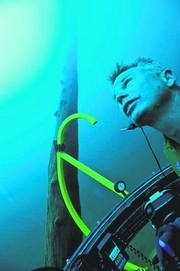
A submerged tree seen from the submersible in the depths of Fallen Leaf Lake is possible evidence of ancient drought that lowered the lake level for centuries. Photo: Reno Gazette-Journal
“RICHARD Schweickert slipped into a world of brilliant blue,” begins a fascinating story in today’s Reno Gazette-Journal recounting a trip by a miniature submarine through the depths of Lake Tahoe.
From the story:
“It reminds me of a helicopter under water,” Schweickert said of the vehicle that offered him a fish-eye view of a major earthquake fault off Tahoe’s north shore.
The two-person submersible, captained by Scott Cassell of the nonprofit Undersea Voyager Project, made more than 40 dives in Tahoe and nearby Fallen Leaf Lake in May. Crews examined earthquake faults, ancient submerged trees and invading species …
For the whole text, click here.
« go back — keep looking »North American Native Plant Societies

After the lawn

Garden blogs
