White House releases climate change impacts report, prognosis grim for Western water
Posted on | June 16, 2009 | 2 Comments

Graphic: NOAA
- Regional differences in climate will become more prounounced. Rain will increase in the Northeast and Midwest and decline in much of the West, in particular the Southwest.
- Substantial changes in the water cycle are expected. A warmer climate increases evaporation of water from land and sea and allows more moisture to be held in the atmosphere. For every 1 degree Fahrenheit in temperature, the water holding capacity of the atmosphere increases by about 4 per cent.
- Changes in atmospheric circulation will tend to move storm tracks northward, with the result that dry areas will become drier and wet areas wetter, hence the Southwest is projected to experience longer and more severe droughts.
- Increased air temperatures lead to higher water temperatures, which have already been detected in many streams, especially during low-flow periods. In lakes and reservoirs, higher water temperatures lead to longer periods of summer stratification, when surface and bottom waters do not mix. Dissolved oxygen is reduced in lakes, reservoirs and rivers at higher temperatures. Low oxygen stresses aquatic animals such as coldwater fish and the insects and crustaceons on which they feed. Lower oxygen levels also decrease the self-purification capabilities of rivers.
- The negative effects of water pollution will be amplified.
- Because climate change will significantly modify many aspects of the water cycle, the assumption of an unchanging climate is no longer appropriate for many aspects of water planning. Past assumptions derived from the historical record about supply and demand will need to be revisited.
Understanding that climate change is upon us is crucial to preparing a response, say spokespeople for the participating agencies and White House.
From the National Oceanic and Atmospheric Administration’s press release:
Responses to climate change fall into two categories. The first involves “mitigation” measures to limit climate change by reducing emissions of heat-trapping pollution or increasing their removal from the atmosphere. The second involves “adaptation” measures to improve our ability to cope with or avoid harmful impacts, and take advantage of beneficial ones. “Both of these are necessary elements of an effective response strategy,” said Jerry Melillo of the Marine Biological Laboratory in Woods Hole, MA, a report co-chair.
“By comparing impacts that are projected to result from higher versus lower emissions of heat-trapping gasses, our report underscores the importance and real economic value of reducing those emissions,” said Tom Karl, director of NOAA’s National Climatic Data Center in Asheville, N.C. and one of the co-chairs of the report. “It shows that the choices made now will have far-reaching consequences.”
The report draws from a large body of scientific information, including the set of 21 Synthesis and Assessment reports from the U.S. Global Change Research Program. The government agencies affiliated with the program include the Departments of Agriculture, Commerce, Defense, Energy, Health and Human Services, Interior, State, and Transportation; the Environmental Protection Agency; NASA; National Science Foundation; Smithsonian Institution; and the United States Agency for International Development.
The report is available for download online.
This report was updated at 9am, Wednesday June 17.
Tags: chance of rain > drought > Emily Green > National Oceanic and Atmospheric Administration
The Colorado River in San Marino
Posted on | June 16, 2009 | No Comments
THIS kind of discretion could put a reporter out of business, or in court, but the essay by photography curator Jennifer A. Watts introducing the “Downstream” exhibit at the Huntington Library, Art Collections and Botanical Gardens is too beautiful to bowdlerize. Better to lift it intact:
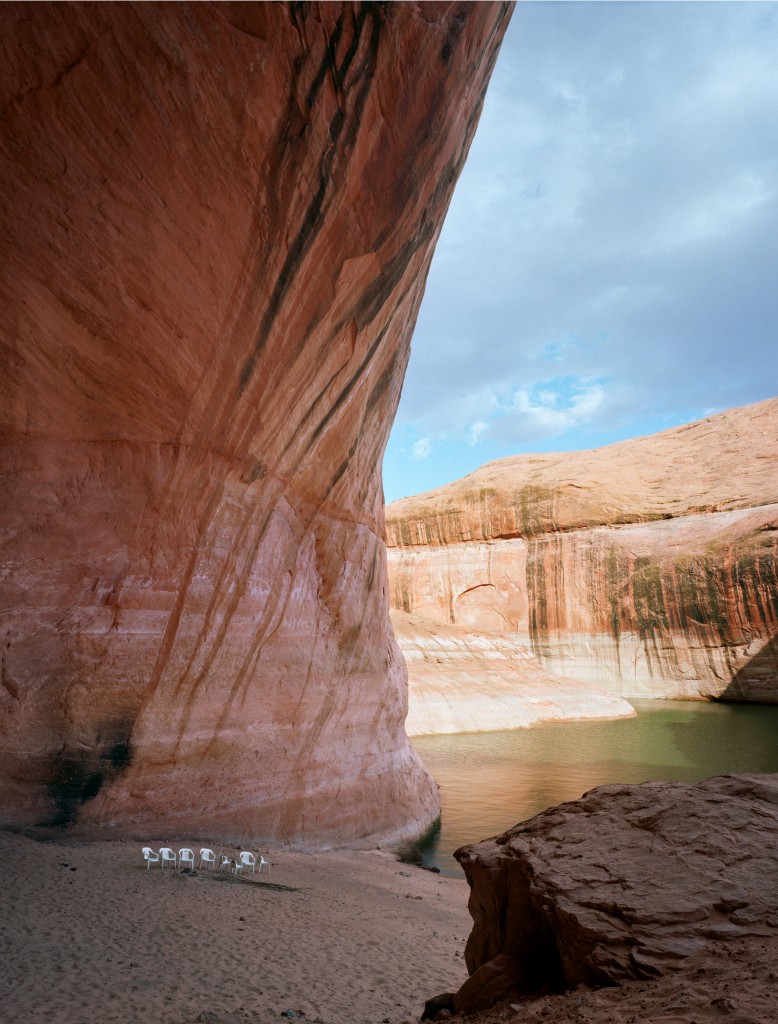
Karen Halverson, Davis Gulch, Lake Powell, Utah from the Downstream series, 1994-1995. Archival pigment print. 24 x 20 in. Courtesy of the Artist.
ONE WINTRY MORNING IN 1994, KAREN HALVERSON (b. 1941) awoke convinced she needed to photograph the Colorado River.
An accomplished artist who had already spent 20 years exploring the American West, she set off on a two-year encounter with the vast, breathtaking terrain along the river’s serpentine route. “The impulse to photograph the Colorado River came to me out of the blue,” she writes, “but I acted on it as if it were my destiny.” Personal destiny and the Colorado River have long been linked in the lives of the explorers, scientists, writers, artists, and thrill seekers who have sought to under- symbol of the American West. Once wild, the river has been tamed by dams built to slake the arid West’s demand for water and power; 30 million people are dependent on it today.
Halverson’s large-format color photography alludes to a 19th-century era of exploration when photographers fanned out across the West to make pictures for scientific and commercial ends. Iconic views by William H. Bell (1830–1910), John K. Hillers (1843–1925), Timothy O’Sullivan (ca. 1840–1882) , and others captured timeless landscapes of fierce, often forbidding, beauty. Halverson western lands. Sprawling cities like Los Angeles, Phoenix, and Las Vegas owe their existence almost entirely to the importation of water from the Colorado River. As Halverson rightly claims, today the river is a “water delivery system,” with its dozens of reservoirs, dams, and diversions ensuring the allocation of virtually every drop for human needs.
Yet Downstream is no visual jeremiad railing against environmental abuse. Nor is it a dispassionate travelogue of the two years Halverson spent hiking, driving, and rafting along the Colorado. The wild terrain that flabbergasted early explorers is still here in the Paleozoic strata of gigantic rock outcroppings, the ancient calm of ghostly canyons, the dizzying heights overlooking a ribbon of water far below. And the colors—ocher, cerulean blue, deep red, electric green—are all inten-sified against the palette of a dammed river running colder and deeper than if it flowed freely. A modern-day beauty even finds itself inscribed in steel and concrete, whether in the sleek form of a pipeline or the still surface of an irrigation canal.
But it is in the bizarre, sometimes humorous, intersections of past and present that Downstream gains its potency. Cheap plastic lawn chairs, sitting vacant, look puny and ridiculous against a looming canyon wall. Weekend revelers pump fists skyward on the shores of Lake Mead, a giant reservoir held in place by Hoover Dam. A garden hose waters a scrawny palm tree in a desert oasis populated by rows of RVs.
….What is gained and what is lost by controlling the Colorado River? And what are the river’s limits? Halverson’s Downstream series asks the viewer to contemplate these questions in a time when the arid West’s thirsty population threatens to overwhelm technological as well as natural resources, and when our well-watered urban lives remain utterly disconnected from riparian realities. Through her resonant imagery, Halverson speaks to the immutability of the river’s past while confronting its complex, contested present and future.
“Downstream: Colorado River Photographs of Karen Halverson,” will be on view through Sept. 28 at The Huntington
This post has been updated.
Tags: chance of rain > Colorado River > Emily Green > Huntington > Karen Halverson > photographs
The grass is always browner on the other side
Posted on | June 11, 2009 | 9 Comments
WHEN George Knapp rumbles, people who care about water listen, even people routinely savaged by him. In April, Knapp and photojournalist Matt Adams won the prestigious George Foster Peabody Award for their KLAS-TV special “Crossfire: Water, Power and Politics,” which gave voice to the outrage and incredulity among conservationists, farmers and scientists over a bid by Las Vegas to drive a 300-mile-long pipeline into the heart of the Great Basin to pump its ground water south.
If you haven’t seen it, watch it. Few evening news programs attempt, never mind master, complicated essays on the cost of urban water in the West. This one does.
As disclosure, I should say that I too addressed the Las Vegas / Great Basin story in a year-long special assignment for the Las Vegas Sun. And by way of bragging, I will add that I too won a prize.
So it’s not necessarily remarkable that Knapp and I should clash. The funny thing is we don’t really clash fact-for-fact on the pipeline story. Where we collided head on today was about conservation as practiced in Las Vegas versus conservation as practiced in Los Angeles.
He lives in Vegas, I live in LA. Today, for Knapp and me, each writing in different publications, the grass was browner on the other side.
Knapp, while dismissing the Lake Mead elevation link as a phony trigger for starting the pipeline, also dismissed Las Vegas’s conservation programs. Rather, writing in Las Vegas City Life, he celebrated what he saw in Los Angeles. “…our idea of conservation is to offer a completely voluntary turf buy-back plan, a program so successful the authority stopped funding it,” he wrote. “Other Southwestern cities like Los Angeles and San Diego are serious about water conservation: Water agencies there have told their customers to cut their use or else face financial consequences. Las Vegas is unlikely to take reasonable steps to cut down per capita water use, even as the authority’s officials wring their hands and warn us how awful the future will be with no water.”
Meanwhile, today in the LA Times, I wrote, “For years Southern California water managers paid scant attention to outdoor water conservation. Then they saw stunning savings achieved in Nevada. According to the Southern Nevada Water Authority, in the last decade, Las Vegas has removed more than 125 million square feet of grass, saving 7 billion gallons of water a year. That’s almost one-tenth of Southern Nevada’s annual water supply.”
Who’s right? In this instance I think I am. According to a SNWA spokesperson, the authority hasn’t stopped funding its cash-for-grass program, though “new limits were added last year to reduce costs — golf courses and large properties can only do so many sq ft per year not the unlimited amount each year that they used to be able to convert. There is also a new funding source (bonds) to fund the program as connection charges which used to fund the program have disappeared due to the economy and no growth in Vegas.”
But that doesn’t make me as right as I’d like to be. Maybe in looking between Las Vegas and Los Angeles, George Knapp and I are comparing one chronic waster to another. Until the June 1 ordinances limiting watering and sudden June 2 announcement that LA was funding a new cash-for-grass program, our gutters have runneth over. Drought? What drought?
But for all the success of Southern Nevada’s program, even a decade into openly declared drought, you see gutters abrim there as sprinkler systems refresh the turf-rims of master planned communities. I’ve seen it and you can bet George Knapp sees it.
I stand by Las Vegas being a model that LA should follow — in murdering grass. But as I look at today’s Whose lawn is browner brinksmanship, it points up the crying need for systematic ways to compare conservation in our western cities, to grade them, and to set conservation goals.
Please could everyone who cares and knows about this weigh in and blog on it?
In the meantime, if you are a gardening reader and not a water politics wonk, instead of watering your lawn, look how lovely the water is when it’s left in the exquisite natural ecosystems that our water authorities are forced to pump.
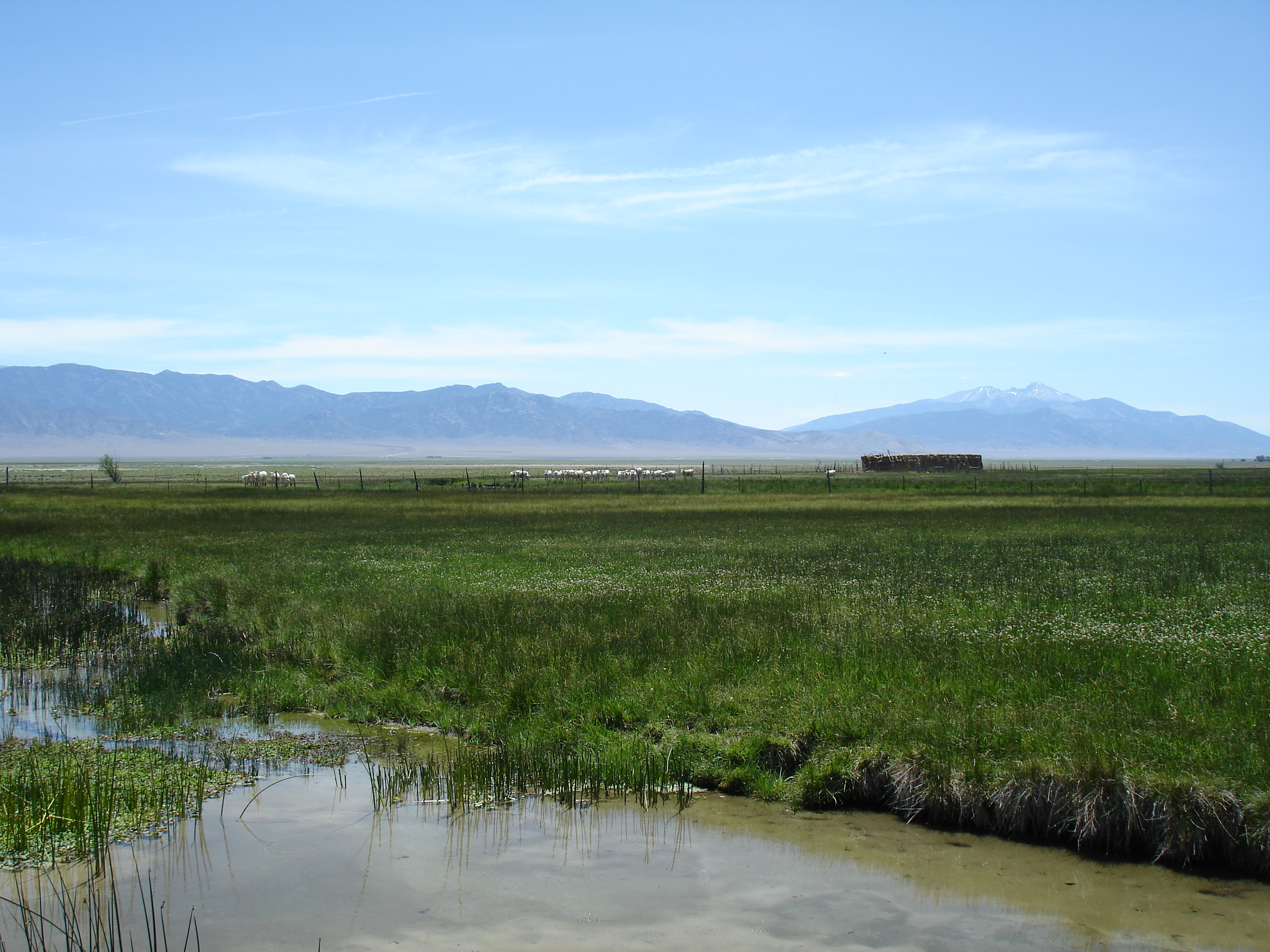
Spring Valley, White Pine County, Nevada. The Southern Nevada Water Authority argues that this water is needed in Las Vegas. Opponents of the proposed SNWA pipeline insist the water is needed where it is to support Great Basin ranching, flora and fauna. Photo: Emily Green
Tags: chance of rain > Emily Green > George Knapp > lawn > Southern Nevada Water Authority > water conservation
Newhall Ranch hearing tonight, environmental impact comments sought
Posted on | June 11, 2009 | No Comments
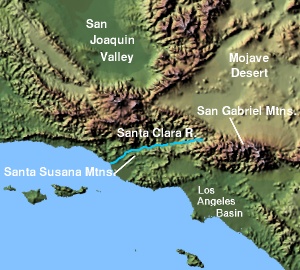
THIS CAME in late, but for those following Newhall Ranch development and Santa Clara River issues, there will be a hearing on the environmental review process tonight, June 11, 6:30 pm at Rancho Pico Middle School, 26250 W. Valencia Blvd, Stevenson Ranch, 91381. A California Native Plant society rally begins at 6pm. CNPS will focus on the endangered San Fernando Valley Spineflower (once believed extinct) on the property in question and request a 120-day extension for comments as people review the environmental documentation. Those who can’t attend but wish to comment should do so by e-mail to Newhallranch@dfg.ca.gov before June 26.
Via Stephanie Blanc, Resource Conservation District of the Santa Monica Mountains and Jessica Hall. Map from Wikipedia
Tags: California Native Plant Society > chance of rain > Emily Green > Newhall Ranch
Smell something? It’s Cadiz, Inc
Posted on | June 11, 2009 | No Comments
PULITZER PRIZE-winning columnist Michael Hiltzik is one of a formidable team of Los Angeles Times reporters, including Frank Clifford, Tony Perry, Bettina Boxall and Duke Helfand, who have been all over the Cadiz, Inc ground water mining wheeze for the last ten years. Today, Hiltzik is back in the Times doing what he does best: Calling a stinker a stinker.
From his report:
People who say that nothing’s harder to get rid of than a bad penny must never have met Keith Brackpool.
The British-born promoter, who has spent the last dozen years pushing a scheme to pump water to Southern California from beneath 35,000 acres his Cadiz Inc. owns in the Mojave Desert, just won’t go away.
On the contrary, he continues to attract political sycophants happy to attest to his wisdom in the ways of water policy — while they accept campaign contributions and consulting fees from him and his company.
In the past his posse has included ex-Gov. Gray Davis and Los Angeles Mayor Antonio Villaraigosa. Now he has added Gov. Arnold Schwarzenegger, who last week publicly endorsed the scheme as “a path-breaking, new, sustainable groundwater conservation and storage project.”
The endorsement was embedded in an announcement Cadiz issued Friday, saying it executed letters of intent with four Southern California municipal water agencies to jointly investigate reviving the water scheme, which was rejected by the Metropolitan Water District seven years ago.
Curiously, the release didn’t identify the four public agencies. Schwarzenegger’s office and a Cadiz spokesman both turned down my request for their names.
So we’re left with a company headed by a man with political juice making a deal with four unidentified public water agencies to revive a $200-million project that was already shelved once.
As taxpayers, do you smell something? Me too.
One might feel better about such maneuvering if Cadiz Inc. were a strong company, but it hasn’t had a profitable year since at least 1999. Last year’s loss was nearly $16 million. The Los Angeles-based company has been kept on life support by its lenders, who have repeatedly extended their loans, presumably on a bet that Brackpool’s project will someday take flight.
At the end of March the company disclosed that its working capital was down to $4.3 million, enough to last another year.
Failure to get the water project moving or to line up new investments by then could force it to cut back in a way that might affect its “viability as a company.”
The whole story is here.
Tags: Cadiz > Cadiz Inc. > chance of rain > Emily Green > ground water > Inc > Keith Brackpool
North American Native Plant Societies

After the lawn

Garden blogs
