High good, low bad: Mead in July 2010
Posted on | August 1, 2010 | 6 Comments

Photograph: Pete McBride on the parched Colorado River delta, by Jonathan Waterman. Click on the image to be taken to Waterman's Colorado River Project.
During a recent discussion of water at the Aspen Institute’s Environment Forum in Colorado, former Secretary of the Interior Bruce Babbitt told a packed house: “The American Southwest is not one of those regions where there is water scarcity. It’s hard to believe, given all the hyping in the national and local and regional press.”
The audience and his copanelists–Sandra Postel, director of the Global Water Policy Project and freshwater fellow for the National Geographic Society, and Pat Mulroy, general manager of Southern Nevada Water Authority (overseeing Las Vegas water)–were taken aback by these statements, writes Jonathan Waterman in the first of a series of Colorado River notes in National Geographic.
Throughout the Southwest, and particularly in a region that I know, the Colorado River Basin, the so called “water buffalos” (those who line their pockets with virtual water) commonly talk about this river as though it has not run dry. If only because the water continues to irrigate 2,000,000 acres of agriculture, run 336 miles into Phoenix and Tucson, 224 miles to Los Angeles, or under the Rockies toward Denver through no less than 12 tunnels. Click here to continue reading Waterman in National Geographic.
Meanwhile, the level of Lake Mead, the main storage reservoir on the Colorado, continues its inexorable drop. At the close of July it was 1,086.97 feet, the lowest that it has been for that month since Mead was filled in the 1930s. Click here for a full set of historical elevations from the federal Bureau of Reclamation.
Sunday’s normal news round-up, “The week that was,” will return next week. Watch Monday for the return of the California legislature and its vote on whether or not to leave the state’s $11bn water bond on the November ballot. On Monday, the Pacific Institute will be releasing an analysis of what the bond would accomplish. Click here for more information. For a full round-up of California water news, go to Aquafornia, the newsfeed of the Water Education Foundation, or to UC Berkeley’s On Water. For San Diego water news, try Groksurf’s San Diego. Or, for all things fresh water, do check in with WaterWired.
Tags: chance of rain > Colorado River > Emily Green > US Bureau of Reclamation
The Dry Garden: Past as prologue
Posted on | July 30, 2010 | No Comments
 The West Adams Heritage Assn. celebrates the preservation of historic houses, but earlier this month, a markedly modern installation in Jefferson Park shared its “best garden” prize. Look at the home of Marina Moevs and Steve Peckman, and it’s obvious why: Few gardens could do a better job accenting but not overwhelming their lovingly restored Craftsman home.

After having taken pains to strip, then stain the clapboard for a weathered, muted effect, the first criterion that Moevs and Peckman put to a local garden designer was to keep the plants low. Herbs would be welcome, but they didn’t want any specimens taller than 3 feet. Furthermore, they didn’t want to water — or at least water often. Finally, they wanted to capitalize on a cash-for-grass program that offers rebates for replacing turf with a low-water alternative.
Click here to keep reading about the Peckman-Moevs project in The Dry Garden in the Los Angeles Times.
Mr Smith goes to council
Posted on | July 27, 2010 | 2 Comments
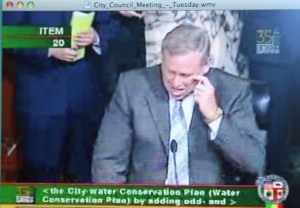
July 6: A laughing Los Angeles City Councilman Greig Smith wipes a tear from his eye as he taunts a Department of Water & Power representative over his success in flouting and, eventually, over-turning the department's hugely successful lawn watering ordinance. The Council is expected to vote in a watered-down ordinance soon. Click on the image to be taken to the city's On Demand video service.
In June 2009, an ordinance limiting lawn and garden watering with sprinklers to two days a week took effect in Los Angeles. Citywide water consumption dropped by more than 20%.
Yet, 13 months later, the ordinance that pushed Los Angeles to the fore of the Western water conservation movement is about to be gutted, having become collateral damage in a roiling brawl over rate hikes and green energy between the City Council and the mayor’s office.
On July 6, the City Council sent the utility a neutered version of the lawn ordinance that would allow watering an extra day a week. Last week, browbeaten Department of Water and Power commissioners quietly rubber-stamped it. What is being passed off as a tweak looks more like a death knell for one of the best collective environmental efforts made by the citizens of Los Angeles.
Click here to keep reading today’s op-ed in the Los Angeles Times on the gutting by City Council of LA’s hugely successful water conservation program.
The July 6 meeting in which Councilman Greig Smith and Council President Eric Garcetti ambushed the Department of Water & Power’s senior water manager is available for view through the city On Demand system, but be prepared to fast forward through a cooking show for senior citizens. Or click below for a transcription of Smith and Garcetti’s performance in the pivotal July 6 Council meeting.
For full background on the infernal and complicated way that two politicians weaponized a hugely successful water conservation program, read the LA Times op-ed. In short, Smith has long been opposed to any regulation of lawn watering, but came up with a three-day alternative to the city’s two-day ordinance in July 2009, an option that he only managed to promote after a series of water main bursts in September 2009. The bursts may or may not have been associated with pressure fluctuations from the two-day rule. But as he openly flouted city law watering his way, Smith’s mantra became that his alternative was better for city pipes. However, he cannot conceal his resentment at being told when to water his lawn and before Council he claimed, against all evidence from the program’s resounding success, that the city residents somehow didn’t understand the rules. “We can trust citizens of LA, they’re not dumb, they’re pretty smart. But when you put together a scheme like this, nobody can figure it out.”
Things only got worse when Council President Eric Garcetti spoke. To judge from the remarks of this co-author with Mr Smith of a successful motion to kill the original DWP lawn-watering ordinance, President Garcetti is either less coherent and environmentally fluent than Sarah Palin, or, more likely, he is lying badly and his collusion with the lawn-loving scofflaw Smith is part of some greater political deal. Either way, be afraid. Be very afraid. As expert on a key point of water policy in dry Southern California, the president of the Los Angeles City Council cites his wife, “who is a big gardener for the last year and a half.”
The week that was, 7/18-24/2010
Posted on | July 25, 2010 | No Comments

"The first time I pulled back the bushes and saw a spring, I knew those magical places would be a permanent part of my life. Our area (north Florida) offers one of the greatest natural wonders on earth. It is a giant, three-dimensional karst terrain that produces a renewable resource.... the finest water on the planet. I can think of no place on the planet more worthy of my attention and love than my own backyard." -- Photographer Wes Skiles, who died last week in a diving accident. Click on the image to be taken to his essay at Florida Springs.com
The man who had filmed where no one had before – whether in the underwater caves of North Florida or on assignment for National Geographic in the blue holes of the Bahamas – died Wednesday in a diving accident off Palm Beach.– Photographer Wes Skiles brought Florida waters to world, Ocala Star-Banner, July 23, 2010
His last story for us, Bahamas Blue Holes, made the August 2010 cover. It’s a testament to Wes’s photographic skills, courage and child-like wonder in the search for the unknown. — National Geographic photo editor Kurt Mutchler, July 22, 2010
Click here to keep reading The week that was
The Dry Garden: In praise of Elmer Avenue
Posted on | July 23, 2010 | No Comments

Elmer Avenue before retrofit. Source: LASGRWC

Elmer Avenue after retrofit. Source: LASGRWC
For all-around grooviness, a Sun Valley block that two years ago had no sidewalks, no street lights, no storm drains and no curbs should be next spring’s hot ticket on the home-tour circuit. Thanks to a newly completed makeover involving one federal bureau, one state agency, as many as six city agencies, three nonprofit groups and 24 homeowners, Elmer Avenue has become the Rolls-Royce of L.A.’s Green Street initiative.
Click here to keep reading in the Los Angeles Times about how the makeover of one block in the San Fernando Valley has resulted in a mass transition to drought tolerant gardens and the capture of 16 acre feet of storm water a year.
« go back — keep looking »North American Native Plant Societies

After the lawn

Garden blogs
