The Dry Garden: She’s back
I met Dryden Helgoe six years ago when she was part of team behind a new landscape at Kidspace Children’s Museum in Pasadena. Shortly afterward, I worked with her on a playground plan for a school garden. During both encounters, she was inscrutable: gracious, spookily competent and distractingly beautiful as a Botticelli angel. Then, by the end of 2005, she was gone — off to start a family.

During the intervening years, I wondered more than once if the choice of stay-at-home motherhood would retire Helgoe. When I met her, she was a rising star. The University of Oregon landscape architecture graduate had a year at the Olin Studio in Philadelphia and five with Nancy Goslee Power & Associates in Santa Monica. Helgoe’s disappearance from the scene left a void.
Click here to keep reading about Dryden Helgoe’s return to landscaping in The Dry Garden column of the Los Angeles …
The Dry Garden: Dig it
The fig beetles seem late this year, and maybe they are. It’s been unseasonably cool for much of the summer. Yet when these drowsy fliers properly known as Cotinis mutabilis appear, it’s a cue. It’s time to empty the contents from the bottom of your compost bins to make room for fresh additions at the top.

Why? These bugs, also called June beetles, are in search of decomposing vegetation in which to lay eggs, where their grubs will become an integral part of the composting process. If you want to enlist these most excellent helpers and prepare your compost bin for fall planting, the time to do it is now.
You will need a pitchfork, a wheel barrow, some burlap, a scoop shovel and fluent profanity.
Click here to keep reading ‘The Dry Garden’ in the Los Angeles Times. Then by all means please return to check newly compiled listings …
The Dry Garden: Zausch and Di
Timing is everything when you’re a plant in a place with little water and lots of competition. Our native California fuchsia, Zauschneria californica, has patience. It remains sedate as the native sages and lilacs burst into spring blossom. Then, as the early bloomers slip into summer dormancy, this discreet gray-green shrub flowers, and flowers, and flowers, often straight through autumn.

Click here to keep reading about Zauschneria californica and its Uruguayan counterpart, Dicliptera suberecta, in The Dry Garden in the Los Angeles Times. Or, if you’re too mad to think about good flowering plants for hummingbirds because you really, really hate someone, buy them this book, reviewed today in the Los Angeles Times.…
The Dry Garden: Heirlooms by trial and error
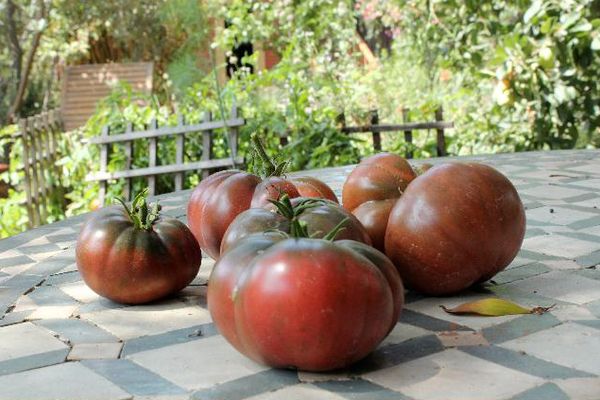
A tomato left to rot in the garden last summer resulted this spring in my eating ripe homegrown heirloom tomatoes by Memorial Day instead of the normal harvest time around the Fourth of July. A fruit dropped in mulch sprouted in October rain, did nicely through winter storms and then, with some watering since May, the vines have been yielding what I’ve decided must be Cherokee Purple tomatoes for going on a month. In terms of flavor, they’re not Black Krims. No other tomato is. The word online is that Cherokee Purples rival Brandywines. That is true. In other words, they’re good enough that, with heirloom tomatoes of this quality costing $3 a pound in farmers markets, I thought I might be on to manna for readers. So I rang UC Davis’ C.M. Rick Tomato Genetics Resource Center to ask why every gardener in Southern California doesn’t plant tomatoes with …
The Dry Garden: Raven at Rancho

Peter Raven, director of the Missouri Botanical Garden, at dusk in a meadow of irises, poppies and sage at Rancho Santa Ana Botanic Garden in Claremont, California, where he was honored for his work on biodiversity last Sunday. “It makes sense that we’ll come to a point where we’re sustainable,” he told the audience. “The question we must ask ourselves now is how long it will take and what we will lose in the process?" Photo: Gary Friedman / Los Angeles Times.
As the program had it, the ceremony at Rancho Santa Ana Botanic Garden in Claremont was to honor Peter Raven. But those who came away from Sunday’s event might be forgiven for believing that Raven, the man Time magazine called a “hero for the planet,” had come to honor Rancho Santa Ana.
For those unfamiliar with Raven, he is to plants what David Attenborough is to animals. He …
« go back — keep looking »North American Native Plant Societies
After the lawn

Garden blogs
