Central Valley groundwater mining detected from space
Posted on | December 15, 2009 | No Comments
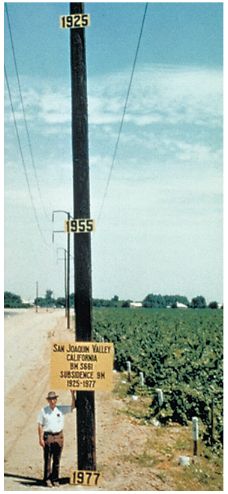
Approximate location of maximum subsidence in the United States identified by research efforts of Dr. Joseph F. Poland (pictured). Signs on pole show approximate altitude of land surface in 1925, 1955, and 1977. The site is in the San Joaquin Valley southwest of Mendota, California. Source: USGS. Click on the image to be taken to a groundwater subsidence fact sheet.
PASADENA, California — New space observations reveal that since October 2003, the aquifers for California’s primary agricultural region — the Central Valley — and its major mountain water source — the Sierra Nevadas — have lost nearly enough water combined to fill Lake Mead, America’s largest reservoir, reports the Jet Propulsion Laboratory. To keep reading the JPL news release, click here.
Legislation that would have required monitoring of groundwater in the Central Valley was gutted at the last minute from the raft of water bills passed by the California legislature this fall at the behest of the agricultural lobby.
This happened in spite of US Geological Survey reports last summer of Central Valley subsidence caused by ground water overdrafts so severe that it threatens the California Aqueduct with collapse. On September 4th, the USGS announced its own satellite study to analyze the threat to the Aqueduct.
To read Peter Gleick, president of the Pacific Institute, on the severity of the Central Valley groundwater overdraft when the the subsidence dangers were publicized last summer, click here and on the lastest NASA study, here. The lowdown: Gleick wants to send the legislature back to the drawing board on groundwater monitoring.
Among reactions from elsewhere around the water wires, economist David Zetland makes no attempt to disguise his disgust at Aguanomics. From New Mexico, the Albuquerque Journal’s John Fleck sees it as a case of tragedy of the common at his personal website, inkstain. On the public record, one of the savvier and easily the funniest water blog in California, crunches JPL’s numbers, finds them consistent with what the state Water Plan estimates, but complains about the mixed measures used to convey the overdraft. As usual, Aquafornia is on all the latest California water stories.
This post was updated at 3.58pm, 12/16/2009. The second Gleick link, the water blog round-up and USGS photo were added.
Tags: Central Valley > chance of rain > Emily Green > Jet Propulsion Laboratory
The week that was, 12/6-12/2009
Posted on | December 13, 2009 | No Comments
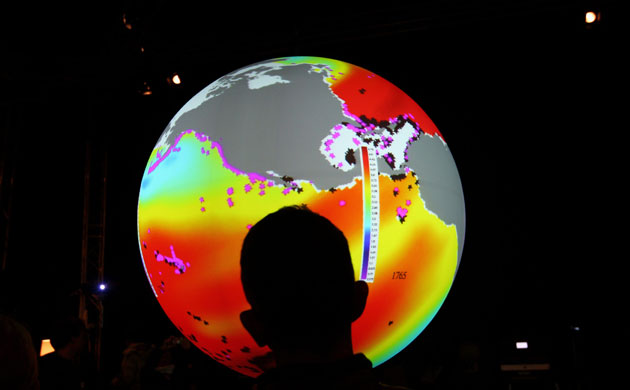
A man watches an animated projection showing the different acidity levels of the ocean. Photograph: Miguel Villagran/Getty Images. Click on the image to be taken to the London Guardian's "Copenhagen in pictures: Day two."
Most of us aren’t chemists, but it’s not hard to understand that a more acidic ocean will change what can live there. — Dave Kubiak, retired teacher and fisherman from Kodiak, Alaska, “Increasingly acidic ocean threatens fish,” Alaska Daily News, December 9, 2009
Click here to keep reading The week that was
The Dry Garden: Capturing the spirit of LA’s streams
Posted on | December 11, 2009 | No Comments
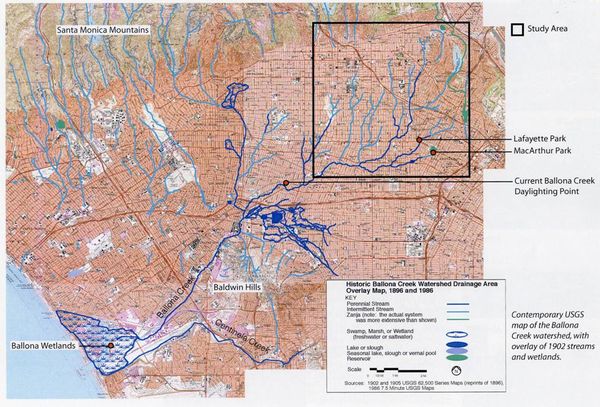
Contemporary map of the Ballona Creek watershed with overlay of 1902 streams and wetlands. Source: "Seeking Streams" by Jessica Hall et al, 606 Studio, Cal Poly Pomona.
WHEN it snows in the mountains and rains in the basin, Jessica Hall thinks of the lost streams of Los Angeles. In fact, she thinks of them all the time. For the last nine years, the 41-year-old garden designer has been retracing the paths of the native creeks, streams and springs that once ran wild before they were filled in and paved for homes.
In the process, Hall has come to believe that the best town planning and landscape design principles for the future may lie in understanding the habits of the watercourses of the past.
Those who missed the profile of Hall last August by Times staff writer Hector Tobar have a treat in store reading about how Hall tracked down Sacatela Creek, a jewel of a waterway that once flowed from what is now the Shakespeare Bridge in Franklin Hills to the Ambassador Hotel in mid-Wilshire. If Los Angeles ever wakes up to the potential of “daylighting” lost waterways, Hall will have been part of the story.
But this column picks up where the Tobar article left off, in particular to ask: What has this Princeton architecture graduate learned chasing streams that may be applied to capturing storm water at home and making the good choices when designing a garden?
Click here to keep reading about Jessica Hall in the Los Angeles Times Dry Garden column.
Tags: chance of rain > Jessica Hall > Los Angeles Times > Los Angeles watersheds
El Nino intensified in November, NASA reports
Posted on | December 11, 2009 | 1 Comment
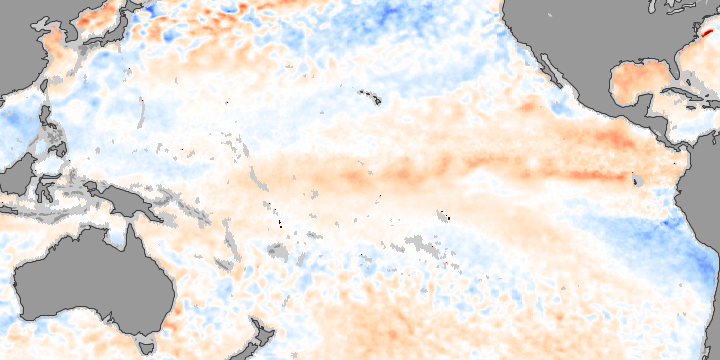 OCEAN conditions known as ‘El Nino’ and associated with wet winters in California intensified in November, reports the NASA Earth Observatory today. For a satellite photo of this week’s storm, click here.

For National Weather Service forecasts of continuing rain, click here. For preliminary rainfall amounts in greater Los Angeles from last night’s showers, here.
Elsewhere around the world and the web, the New York Times has a simple, informative interactive map showing which countries are at the United Nations Climate Conference in Copenhagen and what they seek. To access it, click here. For a Los Angeles Times update from the negotiating floor, click here. For Day 5 of the Copenhagen conference caught in pictures in the London Guardian, click on the kid in the hat.
This post was updated at 12.31pm, December 11, 2009. The Los Angeles Times negotiation report was added.
‘Ghost of Tulare’
Posted on | December 9, 2009 | No Comments
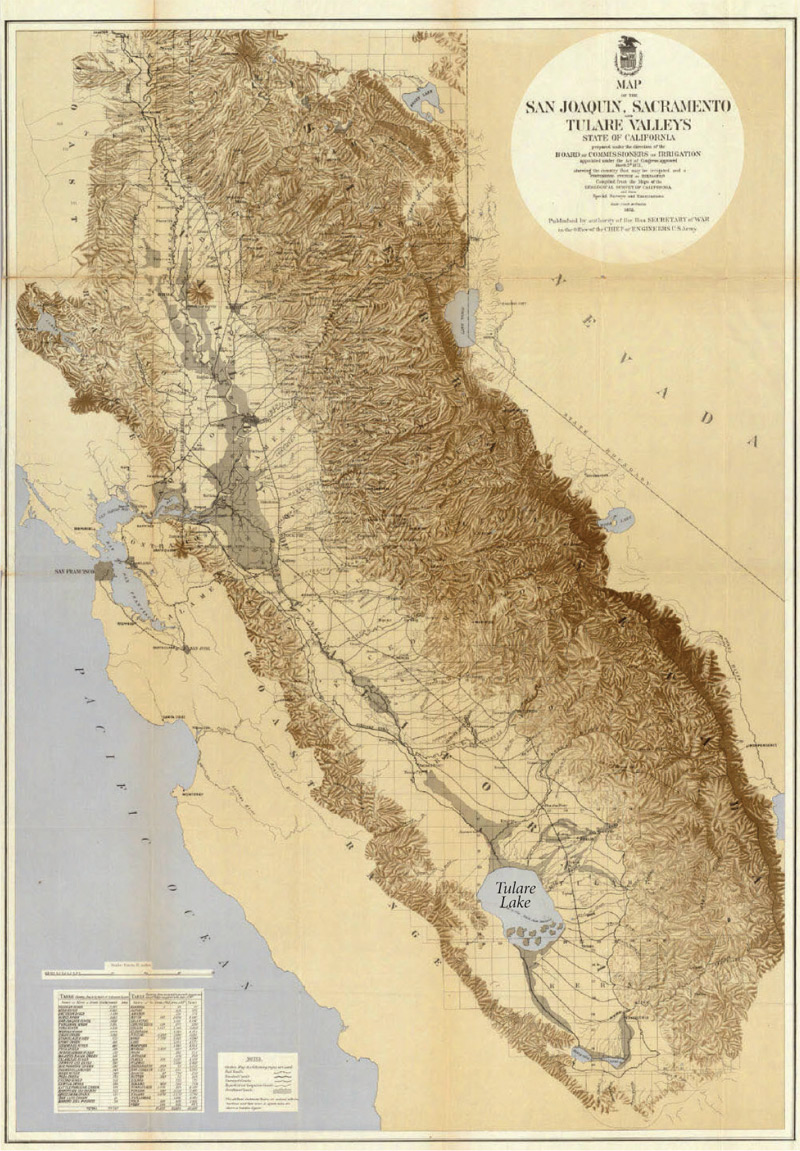 “Tufts of unmilled cotton line Utica Avenue like clumps of dirty spring snow,” writes Judith Lewis in High Country News. “The road is like hundreds of others in the dun-and-green checkerboard of California’s Central Valley, a two-lane highway running straight as a zipper past geometrically arranged almond orchards and vineyards. Steve Haze, a candidate for U.S. Congress, is out here on what he calls “recon,” determined to debunk the local billboard slogans. “Congress-Created Drought” is common in fallow fields, right behind “Food Grows Where Water Flows” and “Water = Jobs.” The signs were put up by corporate growers and water-management leaders, who complain that a federal court decision that reduced their irrigation deliveries to save a tiny fish put thousands of people out of work. Haze thinks the reality is more complicated … He would like to see [Tulare Lake] brought back to life to help solve California’s water problems.”
To keep reading about one man’s dream to restore the lost Tulare Lake, once one of the largest freshwater bodies west of the Mississippi, click here. For the Twitter account of the writer, accomplished LA-based environment reporter Judith Lewis, click here. After reading Lewis’s article, head to a library for a copy of “The King of California,” the story of JG Boswell, whose cotton grows on the Tulare lakebed.
« go back — keep looking »North American Native Plant Societies

After the lawn

Garden blogs
