High good, low bad: Mead in June
Posted on | July 1, 2009 | 1 Comment
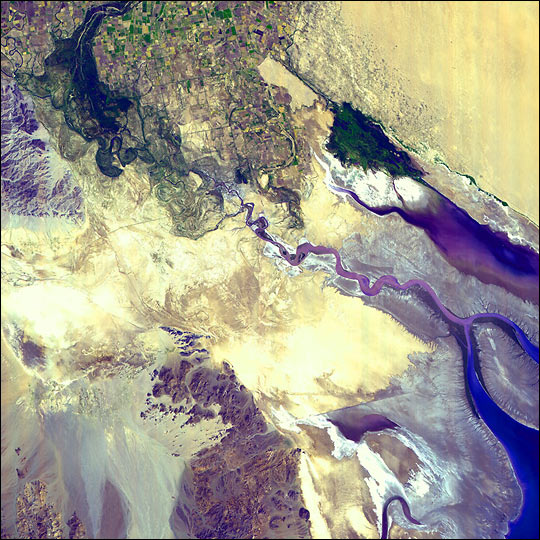
NASA image of the Colorado River Delta in the Gulf of California. Click on image for NASA history of the image and the region.
LAKE MEAD is the Colorado River reservoir holding key water supplies for California, Arizona, Nevada and the Republic of Mexico. The remnants of what was once a vast watershed concluding in the Gulf of California now depend on releases of water from Mead.
DATE ELEVATION OF LAKE MEAD
June 30, 2009: 1,095.26
June 30, 2008: 1,104.98
June 30, 2007: 1,113.50
June 30, 2006: 1,128.26
June 30, 2005: 1,140.46
June 30, 2004: 1,126.93
For May elevations, click here. For April, here. For US Bureau of Reclamation records of Lake Mead elevations, click here. For the shortage sharing agreement between the Colorado River states, click here.
*See Center for Biological Diversity on the Lower Colorado River Multi-Species Conservation Program
This post has been updated on June 2, 2009. A Las Vegas Eyewitness News link about struggling marina operators at Lake Mead posted 12 hours ago has been replaced by the NASA image and the text altered accordingly. The reason? TV has the boaters covered, and so do the scrambling, recreation-industry sponsored politicians discussed in the nightly news report. This blog is more interested in the long-term and environmental consequences of our water use patterns.
Officially dry
Posted on | June 30, 2009 | No Comments
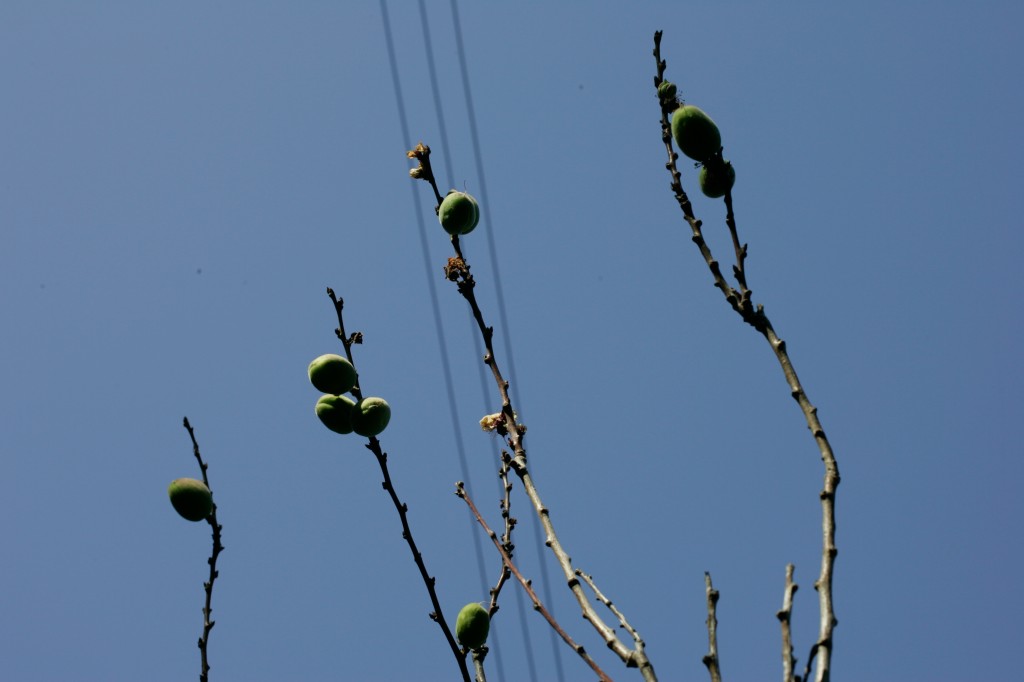 LOS ANGELES is poised today to record its fourth year in a row with below normal rainfall, reports the Los Angeles Times. From July 1 of last year to June 30—the period designated the “rain year”—only about 9 inches fell, compared with the average of just over 15 inches.
For the full story, click here.
Polluters 5, Environmentalists 0: Supreme Court term reviewed
Posted on | June 29, 2009 | No Comments
FURTHER to last week’s 6-3 Supreme Court Decision in Coeur Alaska, Inc v. Southeast Alaska Conservation Council et al, the Center for Law, Energy and the Environment (CLEE) at UC Berkeley will be holding a live Webcast Tuesday June 30, 10-11.30am Pacific Time discussing the environmental record of the concluding Supreme Court term.
Panelists include CLEE executive director Richard Frank and Berkeley professors Dan Farber and Holly Doremus, and assistant professor Eric Biber.
The cases under discussion will include Winter v. Natural Resources Defense Council (environmental organizations’ challenge to the U.S. Navy’s active sonar testing program); Summers v. Earth Island Institute (environmental groups seeking to block the sale of timber from fire-damaged federal lands in California); Entergy Corp. v. Riverkeeper (environmentalists challenging the EPA’s use of cost-benefit analysis for power plant projects); Burlington Northern v. United States (federal government trying a case under Superfund law that would have made Shell Oil and Burlington Northern liable for cleaning up a hazardous waste site) and the Coeur Alaska case (environmentalists challenging the U.S. Army Corps of Engineers permit that allowed a mine operator to pump mining wastes into a pristine lake).
As CLEE notes in its press release, environmentalists lost every challenge. The agenda before the panel is to assess the impact of these recent rulings and the dissonance between the High Court and the Ninth Circuit, analyze the Robert’s Court’s overall environmental law record to date, preview the Court’s upcoming Term, and consider the impact of a probable Sotomayor appointment.
Lake or dump? You decide
Posted on | June 29, 2009 | No Comments
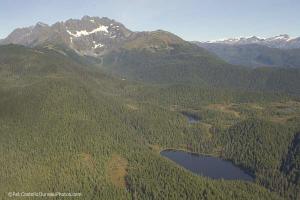
Slate Lake in the Tongass National Forest, Alaska. Photo: Sierra Club.
FOR THOSE wondering about whether there is recourse to the Supreme Court’s Coeur Alaska ruling last Monday, there is.
The decision, which by a 6-3 vote upheld the legality of dumping gold mine waste into Lower Slate Lake in Alaska’s Tongass National Forest, “can be undone in one of two ways,” said Ed Hopkins, Director of Sierra Club Environmental Quality Program. “One is the Obama administration could issue a rule-making and overturn a rule that the Bush administration did in 2002, which essentially created this problem. Or Congress can pass the the Clean Water Protection Act, which would also overturn the 2002 Bush administration rule.”
The Clean Water Protection Act would return the definition of “fill” to its original meaning (ie: not including pollutants), but it has been stymied in the past by advocates of mountain top removal mining in Appalachia. Last Thursday a Senate Subcommittee resumed hearings on the issue.
To read a blistering New York Times editorial on the Supreme Court decision, click here. For a Sierra Club review, click here. Then, if you’re as mad as the author of the New York Times editorial is, write your congressional delegates and the White House. For a Sierra Club primer on how to do that, click here.
Tags: chance of rain > Clean Water Protection Act > Emily Green > Supreme Court
Las Vegas from space over 25 years
Posted on | June 29, 2009 | No Comments
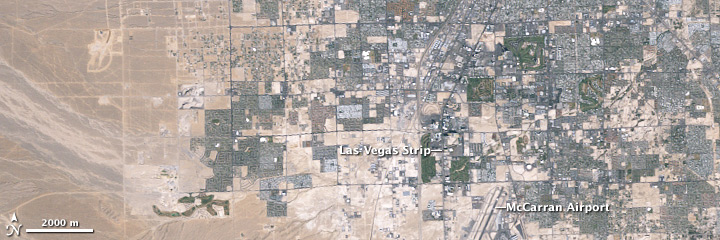
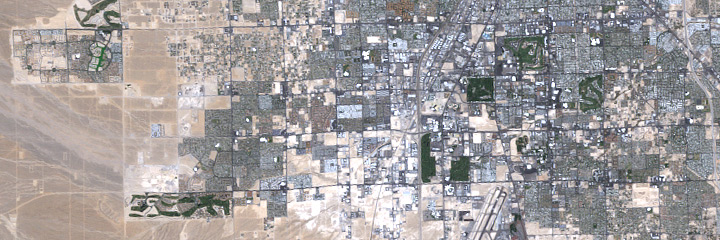
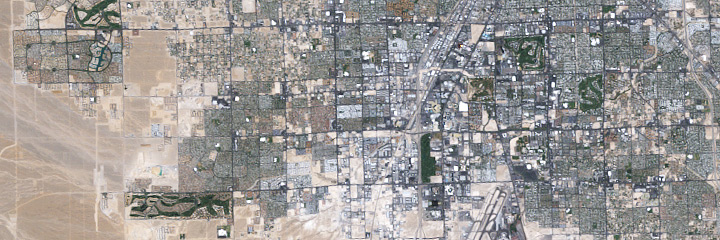
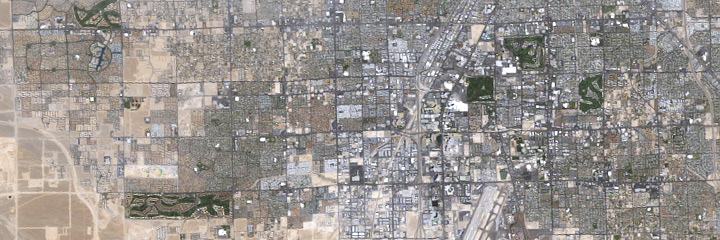
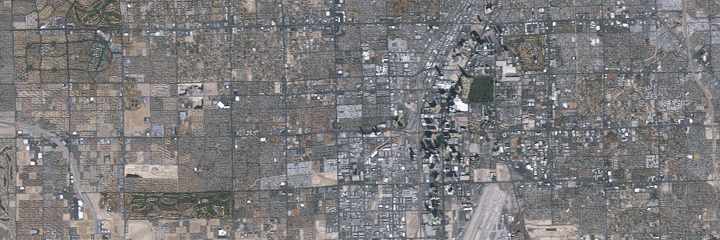
ON MARCH 1, 2009, NASA’s Landsat 5 satellite turned 25. NASA marked the occasion by publishing these photographs of Las Vegas photographed from space over a quarter of a century. The growth caught from above is sustained by an unyielding search for new water in the Mojave Desert below. This posting connects the NASA photos to that search for water.
1984
In 1984, Greater Las Vegas had exhausted its local groundwater, but grew by finally exploiting an allocation from the Colorado River and the nearby reservoir, Lake Mead.
By 1989, (see photo below), it was clear that Las Vegas was outgrowing its Colorado River allocation and the Las Vegas Valley Water District applied for half of the legally available groundwater in the state of Nevada. The plan was to build hundreds of miles of pipeline north to tap the Great Basin Carbonate Aquifer. Using these as yet unapproved but powerfully enticing claims as collateral, the Las Vegas Valley Water District drew together all the local water agencies in Greater Las Vegas and formed the Southern Nevada Water Authority.
1989
Getting northern groundwater would take time for a long permission process to take place. Meanwhile, Greater Las Vegas continued to grow by optimizing Southern Nevada’s allocation from the Colorado River. In 1994, (see photo below) the Southern Nevada Water Authority hoped to get more water from the Colorado River as well as eventually exploiting its claims for northern groundwater.
1994
That didn’t happen. In 1999 (see photo below), the Colorado River entered an epochal drought. The Southern Nevada Water Authority accelerated its plan to get the northern groundwater applications approved so it could build the pipeline into the Great Basin.
1999
In 2006, as Federal environmental impact studies churned along slowly, the Southern Nevada Water Authority began defending its most important rural groundwater claims before the State Engineer of Nevada. The argument: Growth could not be stopped and Las Vegas was the economic engine of the state.
By July 2008, its confidence was so high that the Southern Nevada Water Authority pressed for a speedy final hearing over a key parcel of rural groundwater from the central Eastern basin Snake Valley. But in 2009, the authority was forced to turn that alacrity into requests for delays. Observers suspected that the authority could not produce a convincing scientific model allaying mounting fears about the ultimate impacts of the proposed pumping of the Great Basin. The federal review as to those environmental impacts is ongoing and being managed by the US Bureau of Land Management. While growth has been slowed by the Recession, the Southern Nevada Water Authority presses on with the pipeline plan out of sheer confidence that no state or federal agency will deny water to a major metropolis, whether or not that metropolis ever had a viable plan for sustainable growth.
2009
NASA photos brought to the attention of this blog by the Mother Nature Network via Aquafornia.
Recommended links:
- The Great Basin Water Network
- The Southern Nevada Water Authority
- Great Basin National Park
- US Bureau of Land Management
North American Native Plant Societies

After the lawn

Garden blogs
