In praise of Altadena Hiker and Karin Bugge
Posted on | March 29, 2018 | 25 Comments

Karin Bugge
Granted, it was odd that Jeanne Moreau would be in front of my house in northern Altadena that afternoon in 2011, but there she was, standing in the street not ten feet away, regarding me with a slow, crooked smile unfolding beneath her sunglasses. Barely visible between parked cars, there was a black Labrador retriever by her side. Who knew that the star of Jules et Jim was a dog person?
“Sit, Albert.”
Or that Jeanne Moreau’s dog was called Albert? Pronounced the American way?
Pushing hair from my eyes and pocketing the reading glasses needed in the garden to differentiate rye seedlings from blue-eyed grass, I clambered to my feet to realize, no, it wasn’t Jeanne Moreau. Some other wild beauty had stopped to make sure that the lady prostrate next to her iris bed was weeding, not dying. My rescuer, whose fine hair was escaping in wisps from what remained of a loosely knotted bun was, it turned out, Karin Bugge, a noted local blogger. The creator of Altadena Hiker was doing what she did on so many afternoons: dodging cars with Albert on the steep and sidewalk-less last blocks of Fair Oaks Avenue before the road disappeared into the winding mountain paths of the Angeles National Forest.
That first meeting with Karin won’t stop replaying in my mind this week as friends struggle to absorb news of her death at what her close friend, reporter Kelly Russell, guesses was only age 58.* Having known Karin in person a little, and having read her a lot over the last seven years, she stands unique in my experience of friends and fellow writers. In my imagination, she somehow never lost that first meeting’s sense of mystery and allure. Rather, it increased. Read more
Trump’s Cadiz relies on complicit Democrats
Posted on | September 5, 2017 | 3 Comments
 As US Senator Dianne Feinstein, California Governor Jerry Brown and his Lieutenant Governor Gavin Newsom lined up behind California State Assembly Bill 1000 last Friday, it looked as though the blue state synonymous with Trump resistance had finally driven a stake through the heart of a Mojave groundwater mining project only viable because of 45th administration sleaze.
And yet, it hadn’t.
Rather, the fifteenth project on Trump’s infrastructure list, an eye-poppingly absurd private scheme to pump billions of gallons of groundwater from the Mojave Desert for export to Orange County, appears to have been saved by two up and coming Democrats, State Senate President pro tem Kevin de Leon (D-Los Angeles) and State Senator Ricardo Lara (D-Bell Gardens).
Thanks to the committee chaired by Lara, the environmental protection bill went from near sure passage to somewhere between life support and dead in appropriations.
By contrast, by late Friday night, the Trump-backed Cadiz Water Project was soaring on the NASDAQ. Read more
Change in a place sold for its climate
Posted on | July 20, 2017 | No Comments
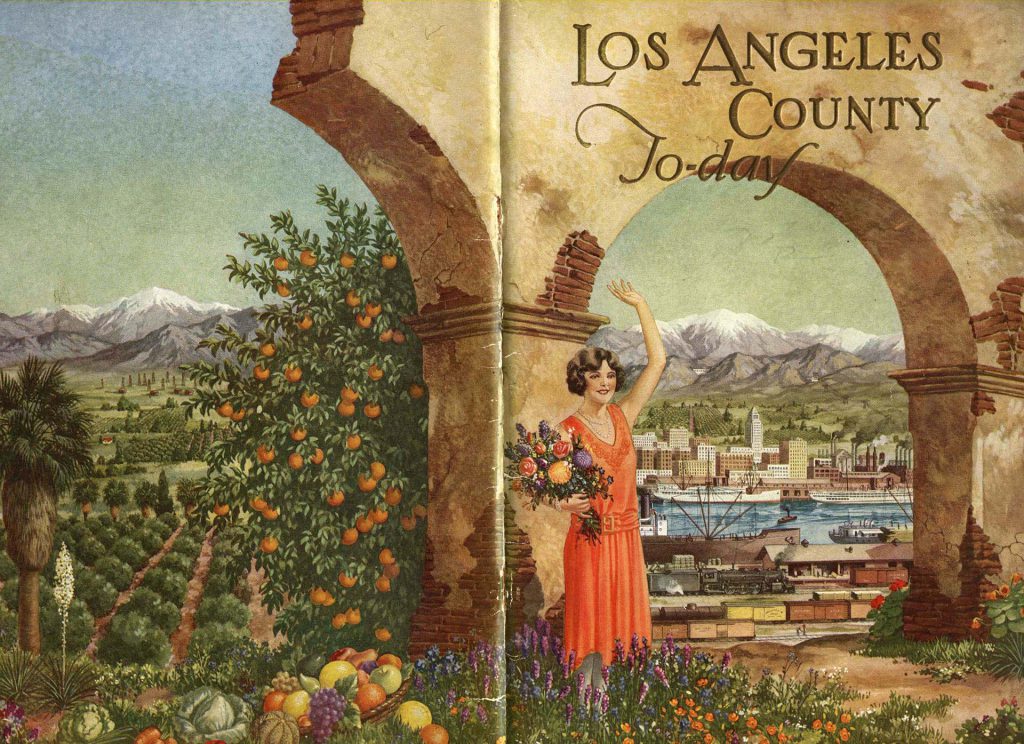
A 1929 brochure of the Los Angeles Chamber of Commerce, courtesy of the Oviatt Library, Cal State Northridge/KCET
Ask an Angeleno to name a plant that is as instantly synonymous with the Southland as the saguaro is with Arizona and the answer will be “palm.” Yet most of the palms dusting the Southland sky are species not native to the U.S. None has its origins in Los Angeles County. The same exotic rule pertains to most of the region’s iconic plants, be they bougainvillea, jacaranda, or bird of paradise. Nowhere else in the country have imported flora so overpowered the native. (Imagine if bamboo and not dogwood were the iconic plant of Virginia.)
Yet, California is different and Southern California is very different. Of the many factors that allowed our garden culture to un-moor itself from evolution, the most fundamental is water. We had it. When it ran low, we imported more. Only now that water has become scarcer and people more common are the plants we grow finally changing. Click here to keep reading “Water, Native Plants, and Southern California’s Long History of Unsustainable Gardening” at KCET.
Weed cloth always fails
Posted on | March 27, 2017 | 5 Comments
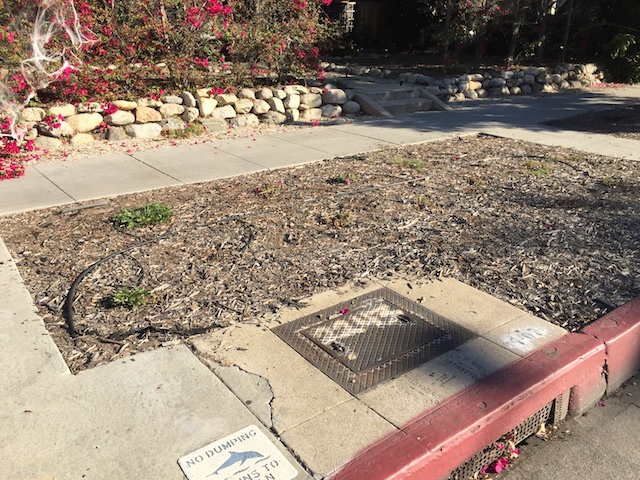
A failing parkway garden in central Los Angeles in which weeds have seeded in drifting mulch that is migrating off rumpled weed cloth. Photo: Emily Green
IF GARDENING know-how is the product of observation over time, then a guideline long overdue for orthodoxy is: Weed cloth always fails. Not sometimes, not most times, but always. Look for the evidence and you start seeing its black lumps protruding like coattails from shallow graves in parkways and tree wells across the country.
This is not about the practice of solarizing, which is a method of killing weeds by overlaying them with plastic sheeting until they cook to death, though there are far more wholesome ways to kill weeds or an unwanted lawn (see sheet mulching). No, this is about a porous synthetic textile also known as “landscape fabric” that has been designed to allow water to penetrate but not air or light, thus depriving weed seeds of two of three essentials for germination. Read more
Rat-proofing row homes in Baltimore
Posted on | January 6, 2017 | 3 Comments
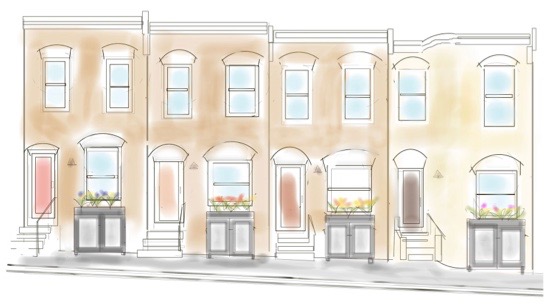
Bin hutches with planters imagined in front of a typical East Coast terrace of row homes. Drawing: Emily Green
When Stephanie Rawlings-Blake’s mayorship of Baltimore is finally judged, her crowning achievement may be having provided residents with rat-proof trash cans. The stout green plastic bins that arrived early last autumn came in two sizes, enormous (roughly 60 gallon) and large (more like 40). After the city dropped them off, as is if over night, the cans radically reduced the amount of skimpily bagged food waste left out on city streets as trash collection days approached. It was so effective that in a recent round table assessing Rawlings-Blake’s tenure, NPR host Tom Hall and his guests were talking trash cans in the same breaths as the former mayor’s handling of the riots and a huge port development deal.
But, months after the roll out, with a new mayor, securing Baltimore’s trash remains a job half done. The former mayor’s veto of the single-use plastic bag ban mean streets and drains are still clogged by persistent waste. The city’s quaintest streets are too small for alley collection so the cans must live out front, where they are eyesores and open to unsavory contributions from passers by. Perhaps their biggest failing is that they only address one waste stream: trash. What rats lost in open garbage on Tuesdays, trash day, they won on Thursdays, recycling day. The new bins did nothing to deny rats greasy pizza boxes and glue-rich Amazon packaging. Read more
« go back — keep looking »North American Native Plant Societies

After the lawn

Garden blogs
