We are all Gulf residents now
Posted on | June 10, 2010 | No Comments

Gulf oil spill transposed to the English Channel. Source: Ifitwasmyhome.com. Click on the map to see how the British Petroleum oil spill in the Gulf of Mexico measures up over your local landscape.
British politicians and the British press have woken up offended by the depth of American anger at British Petroleum. There is a failure of imagination here. The fury would be white-hot if the spill were off British shores and an American company were responsible. No, that’s insufficient. There are no words for how the British would react if the equivalent of the Exxon Valdez spill were gushing into the English Channel every week for nine weeks and counting.
Yet leaving aside the dander of London’s twit of a Tory mayor and his relic friends from the Thatcher era, as the horror at the carnage mounts, and the British have no choice but to get off their high horses and into the toxic morass of this incomprehensible disaster, like it or not of their own making, it’s clear that we are all ultimately responsible, with arguable exceptions for the Amish. One website is driving home the cost of our addiction to oil by asking readers to put themselves in the path of the spill. Ifitwasmyhome.com allows visitors to put in their address to create a map to see how big the spill would be relevant to their known local landmarks. If after doing that finger pointing and shouting still seems appropriate, then by all means do it, preferably in ways that speed progress toward renewable energy and better town planning to wean us from oil. Ifitwasmyhome.com also suggests that we volunteer for clean up efforts or make donations to the National Wildlife Federation or International Bird Rescue.
Click here for the most recent NOAA oil slick forecast
Water spoken here
Posted on | June 9, 2010 | 3 Comments

This USGS poster of the water cycle was spotted on TajikWater.net. It turns out that the USGS has versions in dozens of languages. Click on the image for the international resource.
Butterflies in Claremont
Posted on | June 8, 2010 | No Comments
 A new butterfly pavilion opens to the public at the Rancho Santa Ana Botanic Garden on June 12. Click here for details. For region-wide listings of classes on butterfly gardens, water-wise irrigation, replacing lawn with natives, looks inside the Arboretum library, hikes and preservation efforts, click here for June and here for July.
The week that was, 5/30-6/5/2010
Posted on | June 6, 2010 | No Comments
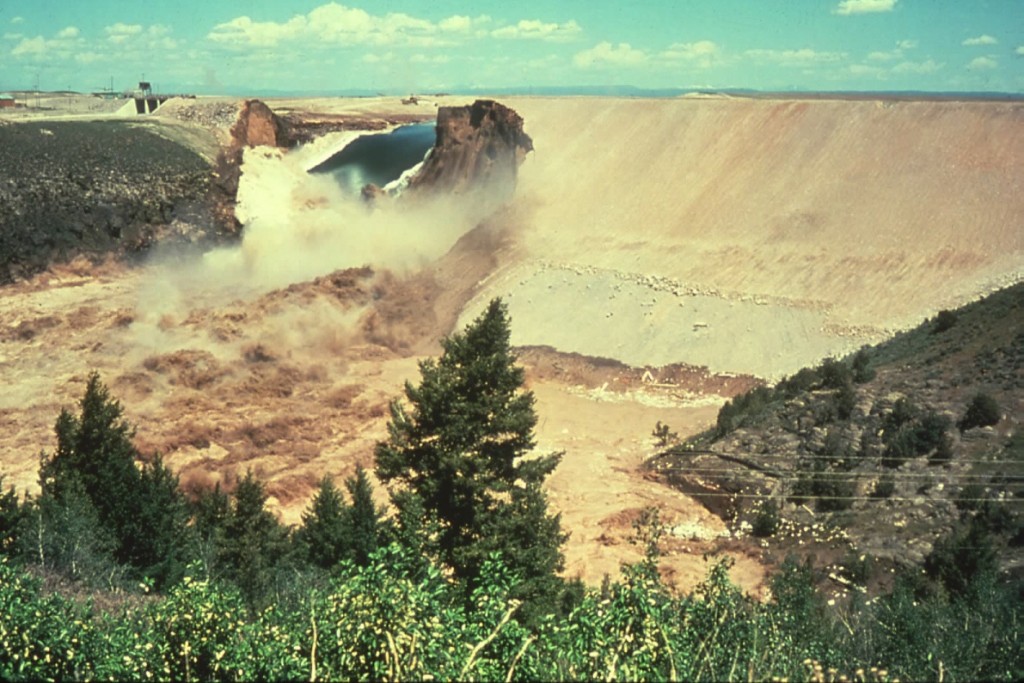
June 5, 2010 marked the 34th anniversary of the failure of Teton Dam. Click on the image for background from J. Davis Roger of the Missouri University of Science & Technology
Thirty-four years ago Saturday, eastern Idaho changed forever. The eight-month-old Teton Dam on the Teton River near Rexburg collapsed on June 5, 1976, drowning 11 people and 18,000 head of livestock and causing $2 billion in damage. — “Time to be blunt. The Teton dam won’t be rebuilt, nor should it be,” editorial in the Idaho Times-News, June 3, 2010

“The only matter that could take Egypt to war again is water.” — Anwar Sadat quoted in “War clouds gather as nations demand a piece of the Nile,” Times of London, June 4, 2010
Ethiopia this month opened the 460MW Tana Beles dam, which would have been considered an act of war in Sadat’s time. A string of new dams are planned to join the Beles on the Blue Nile. On the White Nile Uganda is opening the controversial Bujagali dam. — “Egypt warns that new Nile agreement could prove a ‘death sentence,'” The Independent, May 31, 2010 (Read this, it’s excellent. -ed)
...at least 472 million river-dependent people, some 8% of the world’s population, are estimated to live downstream of large dams and be affected by dam-induced changes in river flows and ecosystem conditions … — Achim Steiner, Former Secretary General of the World Commission on Dams; UN Under-Secretary General and Executive Director UN Environment Programme (UNEP), “WCD + 10: Revisiting the Large Dam Controversy,” Water Alternatives, June 2010
Click here to keep reading ‘The week that was’
The Dry Garden: UCLA in theory and in practice
Posted on | June 4, 2010 | No Comments

Stephanie Landregan, program director of the UCLA Extension Landscape Architecture & Horticulture program. Click on the image to find out about certificate courses. Photo: Emily Green
Nobody ever said that doing the right thing was easy. Students in UCLA Extension’s landscape architecture and horticulture program now learn this before leaving with a certificate. “All of our advanced design classes used to be make-believe,” said Stephanie Landregan, appointed program director two years ago. “Now every one of our advanced classes is involved with the community. Every one of our students has real projects and reality checks. The big ideas get tested.”
Just such a test happened in November, when an undergraduate from UCLA’s environmental science department contacted Landregan wanting to know how his class might introduce a water-efficient landscape somewhere on the 400-plus-acre campus. Landregan partnered his class with a group of her graduate extension students, and the team soon learned that although UCLA might teach environmental ideals, facilities managers practice something else entirely. Every inch of waterlogged sod, every rose bed, was sacrosanct, she said.
Click here to keep reading this week’s Dry Garden column in the Los Angeles Times.
« go back — keep looking »North American Native Plant Societies

After the lawn

Garden blogs
