The Dry Garden: Eco-snooping
Posted on | March 26, 2010 | No Comments
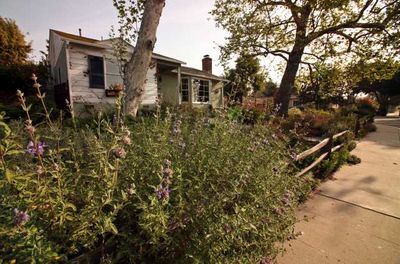
Yes, yes, yes. We all know that native gardens save water, curb greenhouse gas pollution, save homeowners thousands a year on mow and blow fees and entitle their owners to eco-sainthood. But what do they look like? Are they beautiful? If so, are they hard to plant and maintain? Where can you put down the baby? Will those who might want one still be allowed a patch of lawn?
To help Los Angeles homeowners see the almost endless possibilities open after they start incorporating local flora into their gardens, the Theodore Payne Foundation for Wildflowers and Native Plants calls upon its members every spring to open their homes to the public. The upshot is a tour in which the smartest, most experienced native gardeners in Southern California get down with whoever shows up asking for help.
Click here to keep reading the first of a three part series as the Los Angeles Times column “The Dry Garden” previews coastal, inland and foothill gardens from the upcoming Theodore Payne Foundation garden tour.
The anguish of spring
Posted on | March 26, 2010 | No Comments
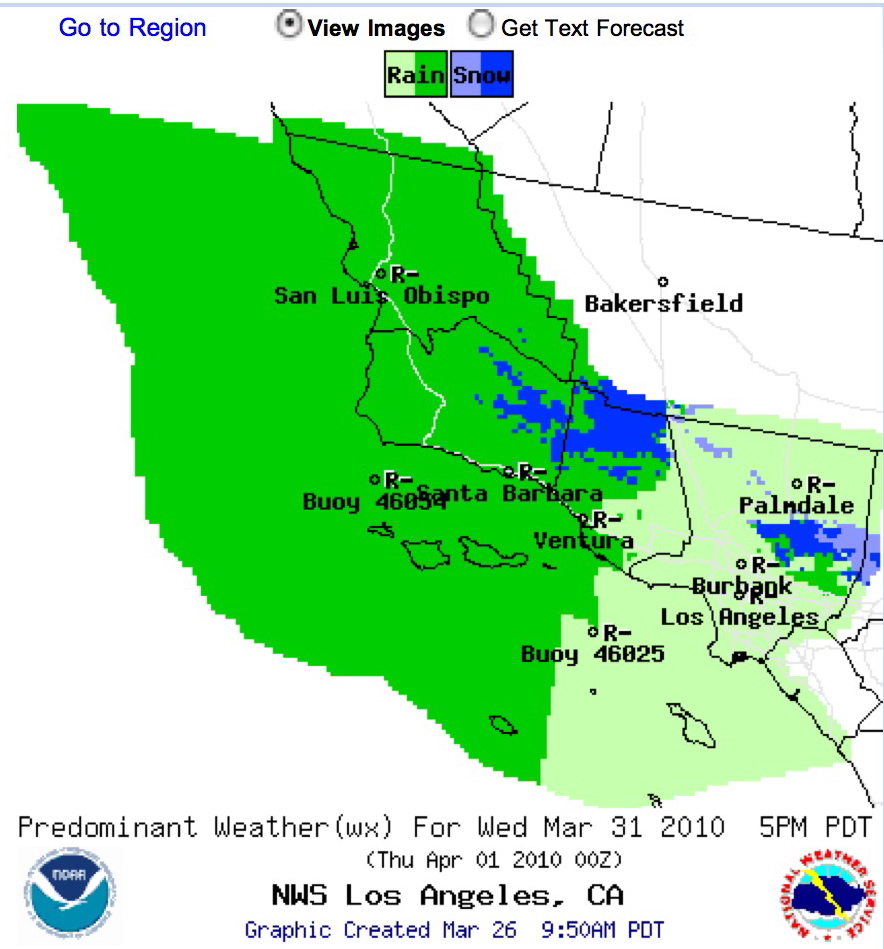
National Weather Service Graphical Forecast detail for Los Angeles, CA, March 31, 2010 as issued on March 26, 2010. Click on the map to be taken to the interactive tool.
Updated 4/1/2010. Earlier this week, this site carried an explanation of why what was supposed to be a wetter than normal year turned out to be a slightly drier one in Southern California. Yet almost immediately meteorologists spotted what may be our last rain of the season. Ken Clark has a chatty explanation on AccuWeather. For those whose hearts only beat faster when presented with cold hard graphics, a similar prediction may be found at NOAA’s Digital Forecast Database. Click on your region, then on the day in the Probability of Precipitation panel. For Los Angeles, the screen tops 50% chance of rain for the evening of Wednesday, March 31st.
Will it come? The anguish of spring in an arid region again brings to mind a passage from Luis Bunuel’s autobiography “My Last Breath” about growing up in Aragon, whose mediterranean climate is almost identical to that of Los Angeles: “Whenever an adventuresome cumulus wandered into view just above the mountain peaks, all the clerks in the grocery next door would rush to our house and clamber up onto the roof. There, from the vantage point of a small gable, they’d spend hours watching the creeping cloud, shaking their heads and murmuring sadly: ‘Wind’s from the south. It’ll never get here.'”
Update, April Fools Day, 2010: Less than .01 inch of rain fell in downtown Los Angeles between midnight and 5am.
Adaptation
Posted on | March 25, 2010 | 1 Comment
 Big problem, big title. The US Environmental Protection Agency Office of Water has issued the National Water Program Response to Climate Change report for 2009. Click here for highlights or to read the full report.
Tags: chance of rain > Emily Green > US Environmental Protection Agency > Water
The water issue
Posted on | March 24, 2010 | No Comments
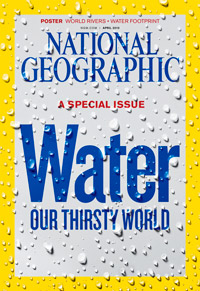 Print editions of National Geographic’s special issue “Water: Our Thirsty World” (now online) will be on newsstands on March 30th. An accompanying exhibit opens at the Annenberg Space for Photography in Los Angeles on March 27th. Among the features is “California’s Pipe Dream,” written by Joel K. Bourne, Jr with photographs by Edward Burtynsky.
Bourne opens, “On a blistering day in the megalopolis that is southern California, Shivaji Deshmukh of the Orange County Water District offers me a cup of cool, clear water that just yesterday was swirling around in an Anaheim toilet bowl … After spending the past century building one of the most elaborate water-delivery systems on the planet replete with giant pumps and thousands of miles of pipes and canals, California has come to this — akin to the last desperate act of lifeboat-bound sailors drinking their own bodily fluids.”
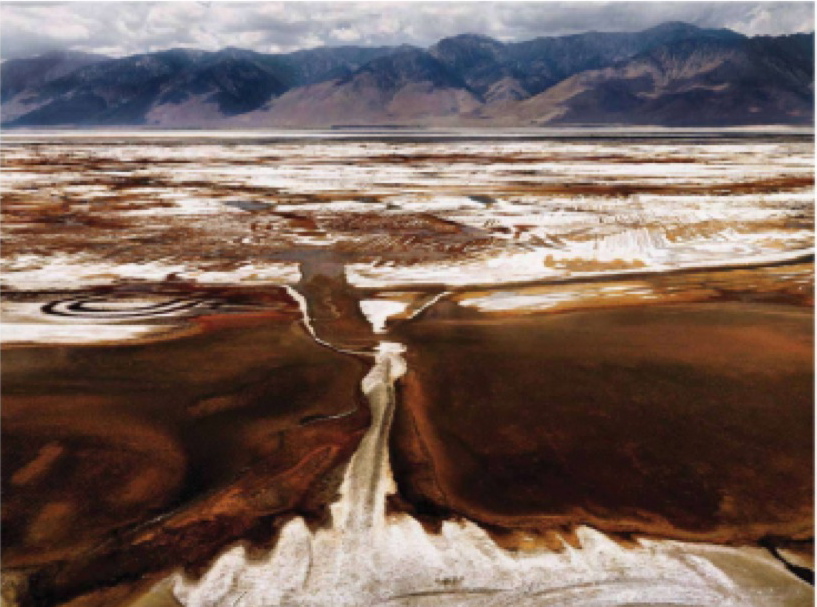
Once a body of water so well fed by Eastern Sierra glaciers that it sustained steam boats, Owens Lake became a salt-crusted valley after being tapped by Los Angeles at the turn of the last century. Photo: Edward Burtynsky / National Geographic
There are few more succinct summaries of California’s water crunch from the Sacramento-San Joaquin River Delta to the Salton Sea than that offered by Bourne’s short, incisive feature. The graphics and photographs explain why no other organization has bested National Geographic for environmental story-telling. Other features cover pending global fresh water shortages, desalination, rainwater harvesting, Asia’s glaciers, holy water, groundwater depletion in the High Plains Aquifer, a photo essay on water towers, vanishing wildlife of freshwater streams, water in recreation, pharmaceuticals in our water supply, how three Middle Eastern rivals are sharing the Jordan River and conservation in the American Southwest.
The Annenberg water exhibit will be accompanied by “Iris Nights” lectures from National Geographic photographers beginning April 1st. Click here for the program.
Goodbye rain, hello JPL
Posted on | March 23, 2010 | No Comments
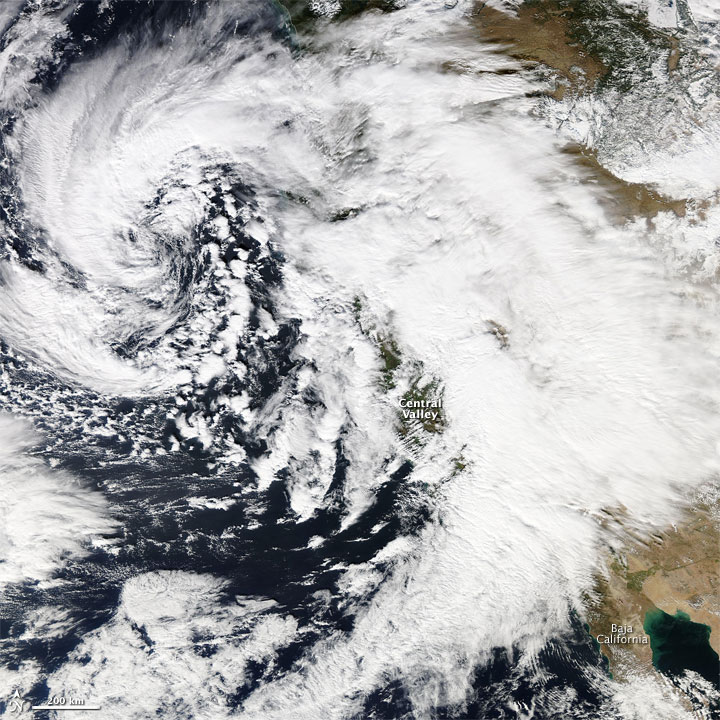
NASA's Earth Observatory captured this image of a large storm over the California coast on January 20th, 2010. This Friday and Saturday, March 26-27, the Jet Propulsion Laboratory in La Canada Flintridge will be hosting two Climate Days in which scientists from NASA and the National Oceanic and Atmospheric Administration will explain to classes and members of the general public the effect of greenhouse gases and clouds on climate, the difference between weather and climate, the role of the ocean in global warming and how scientists study Earth's climate from space. Attendees may participate in hands-on activities, view exhibits, demonstrations, student presentations, play Climate Jeopardy and other games, and get information on careers and resources for teachers and community members. Click on the Pacific storm for more information.
The meteorologist/blogger Bad Mom, Good Mom recently copied me in on a query to Jet Propulsion Laboratory oceanographer Bill Patzert: “It looks like the Pacific high is nearly stationary offshore from us,” she wrote. “No rain thru 3/27 (and probably longer) … is it here to stay for the rest of the spring & summer?”
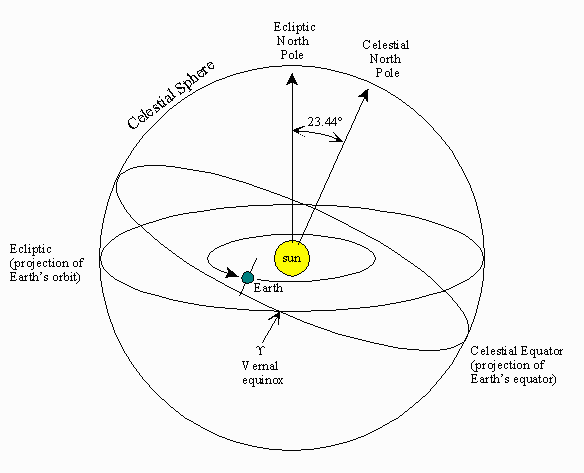 Patzert replied, “After the Vernal Equinox (last Saturday, March 20th), the Northern Hemisphere begins to rapidly warm up. This expands the North Pacific High and shrinks the North Pacific Low. As the High expands and strengthens, storms weaken and go farther to the north of California. Also, winds from the north (the eastern segment of the High) get stronger and upwelling along our coast picks up. Cooler water, more marine layer; thus, May gray and June gloom. The High is strengthening, northerly winds are becoming steadier, there is more coastal and inland fog, and no North Pacific storms … our dry six months.
The upshot for those of us reading the exchange between the two scientists is that the 2009/10 rainy season is ending in Southern California. The precipitation total so far this rainy season for downtown Los Angeles is just shy of normal at 14.66 inches. The average reckoned between 1971 and 2000 is 15.24 inches. The average rainfall for March is 3.14 inches; so far this month we have received .48 inch. “We had early rain in October,” said Patzert. “Usually a wet fall means a dry spring. I don’t see anything over the horizon, but April could surprise us.”
Los Angeles rain gauge:
2009: October 2.07”; November .01”; December: 2.89”
2010: January 4.94”; February 4.27”; March .48”
Click here for NOAA’s online weather data page. Or for an excellent educational foray, click here to be taken to Bad Mom, Good Mom’s feature “Walking my Watershed.”
« go back — keep looking »North American Native Plant Societies
After the lawn

Garden blogs
