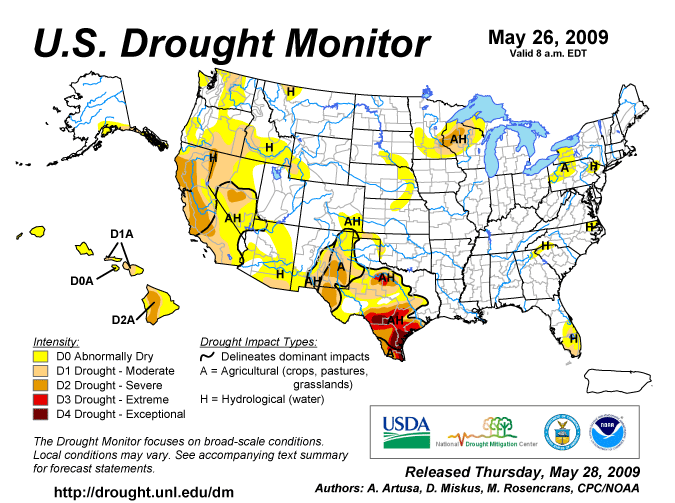
Weekly Drought Map
Posted on | May 28, 2009 | No Comments
Beverly Hills Billionaires Bilk Bay-Delta, Taxpayers Too
Posted on | May 28, 2009 | No Comments
 Poor farmers, except Stewart and Lynda Resnick. The Contra Costa Times reports that in addition to owning more than 115,000 acres in Kern County and the largest pistachio and almond growing and processing operation in the world, the Resnicks’ holding company, Roll International, also owns Fiji water, Pom Wonderful pomegranate juice, and Teleflora, the largest floral wire service in the world. Evidently that wasn’t rich enough, reports an excellent series by Contra Costa Times reporter Mike Taugher. The Resnicks have found a nifty way to profit from water, gleaning 20 cents of every dollar spent on Delta preservation — at the expense of the taxpayer and the environment. Taugher’s stories are linked below. If the links fail, you may need to register with the Contra Costa Times.
2. Paper Shuffle Allows for Easy Money
3. Pumping Water and Cash from the Delta
4. Water Ownership Murky, Complicated
Then brace yourself for what promises to be a scathing report to be released Monday June 1st about management of the Delta.
Via On Water
Tags: Bay-Delta > California Department of Water Resources > chance of rain > Emily Green
Dust Storms Cause Premature Snow Melt in Colorado
Posted on | May 27, 2009 | No Comments
This May 24 report from the Los Angeles Times is must read material for anyone looking at the relationship between the desiccation of the western deserts of California, Utah and Arizona by climate change and ground water pumping, the tearing up of fragile dry land by off road vehicles, and the effect of the subsequent dust storms on Rocky Mountain glaciers. These glaciers are crucial to the Western water supply.
From the story:
- Twelve dust storms barreled into the southern Rockies from the deserts of Arizona, Utah and New Mexico so far this year. In contrast, four storms hit the mountains all year long in 2003.
- The storms leave a dark film on snow that melts it faster by hastening its absorption of the sun’s energy. That, coupled with unseasonably warm temperatures, has sped up the runoff here, swelling rivers to near flood stage, threatening to make reservoirs overflow and fueling fears that there will not be enough water left for late-summer crops.
- Dust can speed up snowmelt by as much as 35 days.
- Ever since European settlement of the West, there has been dust. Initially, grazing cattle kicked up the dust. Scientists say it is now more likely to be caused by off-road vehicles, mountain bikers or energy exploration. In a study last year, researchers found that the amount of dust in the Rockies is five times greater than before the late 19th century.
- Even without the dust storms, forecasters predict that global warming will reduce the soil quality in the western United States to dust-bowl levels by 2050. The Southwest’s temperatures are expected to rise by 10 degrees Celsius by 2100.
- Dust and soot are contributing to the disappearance of mountain snows and the disturbance of water supplies all over the world.
- In California, the Sierra Nevada snowpack gets some soot from Asia and from the state’s own smog-emitting centers, but little dust. State officials have begun to study whether that soot could be contributing to a sped-up snowmelt that, if it continues unabated, could someday overwhelm the reservoir system.
- Because winds in the western United States blow from the southwest, dust from the deserts of California, the Great Basin and the Colorado plateau is deposited on the southern Rockies.
- The amounts of wind-blown dust in the West peaked in the 1920s, reaching seven times the historic norm. Scientists think the level of dust dropped after Congress sharply limited cattle grazing in 1934, near the height of the Dust Bowl. Today, levels are five times the historic norm.
- It is only in the last six years that scientists have begun to study dust’s effect on snow and water supplies.
- This year’s storms put the issue of dust front and center. Mountains that usually remain snow-covered until midsummer are already almost bare along the entire western stretch of Colorado.
Tags: Add new tag > chance of rain > Colorado > dust storms > Emily Green > snowpack
Bay-Delta Water Overcommitted Eight Times, Three in Wet Years
Posted on | May 27, 2009 | No Comments
William K. Reilly, member of the Delta Vision Blue Ribbon Task Force and administrator of the U.S. Environmental Protection Agency under President George H.W. Bush, outlines the crisis in the Delta in the San Francisco Chronicle.
Bullet points from the article:
- The Sacramento-San Joaquin River Delta provides water for more than 25 million Californians and 3 million acres of agriculture, supporting a $400 billion economy. But the delta’s ecosystem is crashing.
- Delta governance is “the critical missing ingredient in water management.”
- The delta water‘s average annual flow is overcommitted to users by more than eight times. Even in the wettest years, the water is overcommitted by three times.
- The Delta Vision Blue Ribbon Task Force work concluded with the release of a strategic plan, but work continues under the banner of the Delta Vision Foundation.
He concludes, “On Monday, we will come together for a public meeting in Sacramento to announce one of the first products of this new, independent organization. Fair warning: The results are disappointing.”
Multi-Species Act needed for Bay-Delta
Posted on | May 26, 2009 | No Comments
SOMETIMES the comments to a posting are as important, if not more important, than the posting itself. When this happens, they need highlighting. This response to the May 21 news that protections for the green sturgeon may cause yet more pumping stoppages in the Bay-Delta falls in that class. It comes from Adan Ortega, Jr., a former vice president at the Metropolitan Water District of Southern California and now a consultant on Western water for the Los Angeles firm Rose & Kindel:
The possibility that protections for green sturgeon will follow those for the Delta smelt points “to the precise reason why California needs a multi-species plan for the Delta,” writes Ortega. “The idea that the Bay-Delta can be restored to a natural state is over 100 years too late. A species by species approach only helps a special niche of lawyers and lobbyists who represent cities, farmers and environmentalists stuck in 30 year-old “solutions.” The levees themselves altered the natural environment in the Delta. The task is not to restore the Delta but to decide how California will prioritize all that depend upon it – humans, fish/birds/plants, cities, farms – as well as how to manage the circumstances that affect it including short-term floods, changing sea levels, drought, pollution, and population growth. Like it or not, we are left to play God.
Tags: chance of rain > Emily Green > endangered species > State Water Project > Water
North American Native Plant Societies

After the lawn

Garden blogs
